Showing posts with label picture book. Show all posts

Saturday, October 13, 2012

We Are America by Walter Dean Myers

Myers, Walter Dean. 2011. We are America: a tribute from the heart. Ill. by Christopher Myers. New York, NY: HarperCollins Children's Books. ISBN 060523085

Summary:
In free verse enhanced by quotations from American history and mural-style illustrations, Myers creates a portrait of America from its native people to the children of the future with allusion to so many events, people, and ideas that have shaped the nation.  

Analysis:
Myers manages in a few lines to chronicle several hundred years of history while capturing the spirit of freedom and striving that have always defined success in America.  The poem’s words, though powerful and vivid on their own, are difficult to separate from Christopher Myers’s artwork.  Historical figures and iconic images from history appear alongside young, colorful, hopeful faces of Americans in harmony with the poem.  The imagery of the poem is strong, using metaphor and other poetic device to convey powerful emotion.

Awards & Reviews:
NCTE Notable Poetry List 2012
CYBILS Award Finalist 2011
Kirkus Reviews:  "The poetry and the paintings will be an excellent jumping-off point for discussions."
From Publisher's Weekly:  " . . . few will be unmoved by this stirring and provocative collaboration."

Connections:
  • Share the author notes from the book and show students the video (below and at http://www.youtube.com/watch?v=oDQXjG0hjLQ) of the poet and illustrator discussing the inspiration for the poems.
  • Explore the companion website Who Is America? (http://www.who-is-america.com/) and encourage students to create video responses for the site.
  • Use the historical events alluded to in the poem or depicted in the illustrations as well as the quotations to introduce history lessons/discussions.  
  • More poetry/art by Walter Dean Myers & Christopher Myers:

Myers, Walter Dean. 1997. Harlem: a poem. Ill. by Christopher Myers. New York: Scholastic Press. ISBN 0590543407
Myers, Walter Dean. 2006. Jazz. Ill. by Christopher Myers. New York: Holiday House. ISBN 0823415457
  • America-inspired poetry:
Borden, Louise. 2002. America is--. Ill. by Stacey Schuett. New York: Margaret K. McElderry Books. ISBN 0689839006
Hopkins, Lee Bennett. 2000. My America: a poetry atlas of the United States. Ill. by Stephen Alcorn. New York: Simon & Schuster Books for Young Readers. ISBN 0689812477
Panzer, Nora. 1994. Celebrate America: in poetry and art. New York: Hyperion Books for Children. ISBN 1562826646


Saturday, September 29, 2012

Easy Work! An Old Tale retold by Eric A. Kimmel, illustrated by Andrew Glass


Bibliography:
Kimmel, Eric A. 1998. Easy work! an old tale. Ill. by Andrew Glass. New York: Holiday House. ISBN 0823413497

Plot:
Kimmel takes a traditional Norwegian tale of a man and woman switching roles and sets it on America’s frontier. Mr. and Mrs. McTeague travel the Oregon Trail to a new life.  When Mr. McTeague comes home each night worn from his hard work clearing the land for their farm, he is doubtful that Mrs. McTeague’s responsibilities can cause nearly so much fatigue.  Mrs. McTeague’s suggestion that they switch roles for a day results in a predictably humorous disaster as he discovers that Mrs. McTeague’s jobs may not be such “easy work.”

Analysis:
As he describes in an author’s note at the end of the text, Kimmel was inspired to write this story by an anecdote from the life of suffragette Abigail Scott Duniway in which she listens to a farmer boast of the life of ease his wife enjoyed and discovers that the wife is at home chopping firewood. Kimmel found a connection between Mrs. Duniway’s experience and the traditional Norwegian tale “The Husband who Was to Mind the House” and set his version of the tale on Oregon’s frontier. Mrs. McTeague is portrayed in the story as hardworking like the farmer’s wife, patient in face of her husband’s complaining, and forgiving of the mess that he creates while the husband comes across as bumbling, boastful, and inept.

The American setting does not alter the tale much from the original.  Both versions challenge the concept of gender roles and “men’s work” versus “women’s work” in a way that may seem obvious to a modern reader but would have been more revolutionary when the tale originated.

Glass’s illustrations complement the story well especially capturing the comic aspects of the story in vivid colors.  The colloquialisms used in the dialogue by Mr. McTeague connect to the oral tradition of storytelling.

Awards & Reviews: 
From Booklist: “Kimmel’s version of a story that has become a staple of feminist folktale collections will be a cheery alternative to, say, P. C. Asbjornsen and J. E. Moe’s The Man Who Kept House (1992) and a good replacement for Wanda Gag’s out-of-print Gone Is Gone.”

School Library Journal review: “ . . . Easy Work would make an enjoyable addition to most collections.”

Connections:
  • Use in a storytime with farm stories. 
  • Use in conjunction with other texts both fiction and nonfiction about the Oregon Trail (especially Apples to Oregon by Deborah Hopkinson, illustrated by Nancy Carpenter)
  • Share the author note that details Kimmel’s inspiration for the story and make connections to women’s rights/suffrage.
  • For older children, this story would be good to compare with its other versions and variants:
Asbjørnsen, Peter Christen, and Jørgen Engebretsen Moe. 1963. East of the sun and west of the moon and other tales. New York: Macmillan. 

Gág, Wanda. 1935. Gone is gone, or, The story of a man who wanted to do housework. New York: Coward-McCann, Inc.

Goode, Diane. 1992. Diane Goode's book of silly stories & songs. New York: Dutton Children's Books. ISBN 0525449671

Gurvin, Abe. 1968. The husband who was to mind the house. New York: Young Readers Press.

Littledale, Freya, and Molly Delaney. 1987. The farmer in the soup: retold from the Norse Tale, the husband who was to mind the house. New York: Scholastic Inc. ISBN 0590401947

Friday, September 28, 2012

Joseph Had a Little Overcoat by Simms Taback


Bibliography:
Taback, Simms. 1999. Joseph had a little overcoat. New York: Viking.  ISBN 0670878553


Plot:
Based on a traditional Yiddish folk song, Taback’s tale follows the titular character as he takes his old and frayed overcoat and repurposes it into increasingly smaller garments as each one wears down.  In the end, Joseph loses the button, the smallest portion of the overcoat he has left, but he takes the nothing he has left and creates the book.

Analysis:
The text is simple and repetitive in structure as Joseph goes through smaller and smaller fragments of his overcoat, but the collage illustrations support it beautifully with bright colors and humorous and subtle details.  The book also incorporates die-cut holes in the pages that provide clues about what garment Joseph will create next.  This clever device is itself a type of recycling, utilizing the previous illustration to make the next and reinforcing Joseph’s actions in the story.  The illustrations also support the cultural roots of the source material, from the dress style of the characters to the Yiddish phrases in the background.

The cumulative nature of this folk tale will help younger readers to engage in the story by anticipating and predicting what comes next.  This pattern of refrain will be a familiar storytelling device to most readers which will likely increase its appeal.

Awards & Reviews:
2000 Caldecott Medal
2000 ALA Notable Children’s Book
From Publisher’s Weekly: “With its effective repetition and an abundance of visual humor, this is tailor-made for reading aloud.”
School Library Journal review: “A book bursting at the seams with ingenuity and creative spirit.”
Booklist: “Taback's mixed-media and collage illustrations are alive with warmth, humor, and humanity.”

Connections:
·        Use in a storytime about clothing or getting dressed.
·        Since the story is based on a song, teach the children the English version included in the book.  Try to find a recording of the Yiddish version as well.
·        Use the book to introduce a discussion of reuse or recycling or for a craft program that repurposes used paper or fabric.
·        Other picture books that use die-cut pages to enhance the story or illustrations:
Carle, Eric. 1987. The very hungry caterpillar. [New York]: Philomel Books. ISBN 0399208534
Emberley, Ed. 1992. Go away, big green monster! Boston: Little, Brown. ISBN 0316236535
MacDonald, Suse. 2009. Shape by shape. New York: Little Simon. ISBN 1416971475
Taback, Simms. 1997. There was an old lady who swallowed a fly. New York: Viking. ISBN 0670869392

Saturday, September 15, 2012

The Pigeon Finds a Hot Dog by Mo Willems


Bibliography:
Willems, Mo. 2004. The pigeon finds a hot dog! New York: Hyperion Books for Children. ISBN 0786818697

Plot:
The pigeon, a beloved character from Willems’s earlier book, finds a hot dog, as the title suggests.  Duckling comes along and is immediately interested in the find.  Through uncluttered illustrations, the story unfolds, with Duckling’s questions showing an ever-increasing desire for the hot dog and Pigeon demonstrating a rising frustration.  In the end, the two share the hot dog, just as it seems the Duckling intended all along.

Analysis:
As a sequel to the Caldecott Honor Book Don’t Let the Pigeon Drive the Bus, this installment features the same emotive, wily Pigeon.  He may have met his match in the Duckling, whose sly questioning provokes but ultimately leaves the Pigeon with only once choice:  to share.  The simplicity of the crayon drawings, the pastel colors, and the lack of background scenery highlight these characters and complement the sparse dialogue that is the book’s only text.  Willems is able to convey much humor and expression despite the lack of complexity in both drawing and text. 

Awards & Reviews:
Publishers Weekly Best Book of the Year, Editor’s Pick, and Starred Review:  "Readers of all ages won't be able to resist miming the sly conversation in this satisfying sequel.”

School Library Journal review: “Willems's deceptively simple cartoon drawings convincingly portray his protagonist's emotional dilemma.”
Horn Book Magazine review:  “Maybe the pigeon's shtick isn't as original this time around, but he's such an engaging character that it's still a treat to see him again.”

Connections:
  •  Use with preschool children in storytime or lesson about sharing.  Ask if they can predict what the Duckling’s idea is before the last page.  Eat hot dogs as a snack.
  •  For older children, use in conjunction with comic strip collections and compare to Willems’s cartoonish characters.  Have children write their own comic panels.
  • Allow children to visit www.mowillems.com or www.pigeonpresents.com to find out more about the author or to play Pigeon games.
  • Other Pigeon books by Willems:
Don’t Let the Pigeon Drive the Bus ISBN 078681988X
Don’t Let the Pigeon Stay Up Late ISBN 0786837462
The Pigeon Wants a Puppy ISBN 1423109600
The Duckling Gets a Cookie
ISBN 1423151283

Grandpa Green by Lane Smith

Smith, Lane. 2011. Grandpa Green. New York: Roaring Brook Press.


Plot:
A young boy tells the story of his great-grandfather's life from his childhood on a farm through war, marriage, and family to his current, sometimes forgetful old age.  The boy's tale is illustrated with  topiaries that depict the stages and events of Grandpa Green's life, and in the end, readers see that Grandpa is creating these living memories in his garden.

Analysis:
This inter-generational story benefits both from the authentic voice of the young narrator and the vivid and whimsical illustrations.  The characters and background scenes are pen and ink drawings, largely black and white with pale green accents which highlight the topiaries on each page.  Each textured sculpture represents a stage or description of the grandfather's long life.  Bits of red highlight certain of the topiaries.  Each page is full of rich detail in both the topiary trees and the young narrator as he interacts with the scenery and collects all the lost items that his grandfather has forgotten.  The gatefold illustration at book's end may show the visual representation of Grandpa Green's life, but it's clear by the poignant narration that more than just the garden will remember these details and stories. 

Awards & Reviews:
Caldecott Honor Book
Junior Library Guild Selection
Publishers Weekly Best Children's Book & Starred Review:   "It's a rare glimpse into Smith's softer side--as skillful as his more sly offerings, but crafted with honesty and heart."
School Library Journal Best Book & Starred Review: "There is harmony in the overall design yet each page surprises and delights . . .  With each subsequent reading, it offers new layers of meaning and visual connections."
Kirkus Reviews: "Readers who slow down will be rewarded by this visual feast that grows richer with each visit."

Connections:

Stewart, Sarah. 1997. The gardener. Ill. by David Small.  New York: Farrar Straus Giroux. ISBN 031236749X
Say, Allen. 1993. Grandfather's journey. Boston: Houghton Mifflin Company. ISBN 0395570352
DePaola, Tomie. 1973. Nana Upstairs & Nana Downstairs. New York: Putnam. ISBN 0399203001
Juster, Norton, and Christopher Raschka. 2005. The hello, goodbye window. New York: Michael di Capua Books/Hyperion Books for Children. ISBN 0786809140

The Snowy Day by Ezra Jack Keats


Keats, Ezra Jack. 1962. The snowy day. New York: Viking Press. ISBN 0670654000

Plot:
Peter wakes up one morning to find his world covered in a blanket of snow.  He sets off in his snowsuit to explore and experience, bringing home a snowball souvenir in his pocket.  He dreams that all the snow is melted but wakes to find more snow falling and sets off on another adventure at book's end, this time with a friend.

Analysis:
The Snowy Day has long been considered a classic of children's literature.  Were it written today, it would still be notable for its illustrations, a mixture of watercolor and collage accompanying the text that captures the day with both wonder and realism.  Fifty years ago when the book was originally published, its depiction of Peter, an African-American protagonist, was nothing short of revolutionary in the world of children's books and gave a generation of African American children a book character who looked like them and lived where they lived. 

The illustrations depict an urban landscape in bright colors that is obscured by mountains and drifts of snow.  Keats's city snow is no pristine or pastoral white but rather washed with hints of pale colors against which Peter's bright red snowsuit boldly shines.  The simple text is brought to life by the pictures that follow the words of the story faithfully.  The dilemma of the melted snowball from his pocket is one that will resonate with young readers, while the ending promises Peter and readers another chance to experience a snowy day.

Awards & Reviews:
1963 Caldecott Medal
New York Public Library’s 150 most influential books of the 20th century
Publisher's Weekly review: "pays homage to the wonder and pure pleasure a child experiences when the world is blanketed in snow."
From Book Links:  "The author brought bold, bright color and collage to the forefront of children's literature."

Connections:
  • Share this book with other Keats books featuring Peter (Peter's Chair, A Letter to Amy, Whistle for Willie, Hi, Cat!, Pet Show, and Goggles) to show children how the character grows and develops over time.  Ask children to pick out elements or events that show Peter is maturing.
  • Explore the Ezra Jack Keats Virtual Exhibit at the de Grummond Children's Literature Collection at The University of Southern Mississippi (http://www.lib.usm.edu/legacy/degrum/public_html/keats/main.html)
  • Study other books and illustrators who use collage such as  Eric Carle, Lois Ehlert, Leo Lionni.
  • Other books about winter/snow:

Briggs, Raymond. The Snowman ISBN 0241100046

Fleming, Denise. The First Day of Winter ISBN 0805073841
London, Jeremy.  Froggy Gets Dressed ISBN 0670842494

Wednesday, August 1, 2012

Sample Program: Elementary Age


Theme:  Origami

Target Audience:  3rd-6th grades

Rationale:  Origami books are in high demand in our children’s department, and as a result, we have a quite extensive and relatively new collection of origami books for various skill levels.  The interest also indicates that an origami-themed program will be well-received by patrons. Sullivan (2005) endorses arts/craft programs as entertaining and enriching options for school-age children and further suggests using books to reinforce the craft activity for older children instead of the storytime method of using a craft to reinforce the books.  Craft programs can be a great way to highlight the both the nonfiction and fiction collections.

Day/Time:  During the school year, we have weekly after-school programs on Wednesdays at 4:00, and we have a weekly craft program on Saturday afternoons at 3:00 year round.  This program could be offered at either of these times.  Both programs typically last forty-five minutes to an hour.

Set-up:
  • Recruit volunteers to help guide activities. An adult origami club meets weekly at our library. Use that group to find one or two “experts” who can come and demonstrate techniques and provide assistance to the program participants. Ask them to bring a few sample pieces that are more complex to show the participants. Make use of teen volunteers who have listed origami/crafts as one of their interest areas on the volunteer application.
  • Promote program on print calendar, on library website’s events calendar, children’s department facebook page, and with print flyer (attached). Contact school media specialist/art teacher contacts about posting flyer in schools.
  • Purchase origami paper. A package of 200 sheets is usually around $6 or $7 at most craft stores. If funding is an issue, use colored paper from library supply and cut into squares. Recycled paper with writing on only one side can also be used for most projects.
  • Select projects at beginner, intermediate, and advanced level from origami instruction books in collection. Complete a sample of each project chosen. Search youtube for demonstration videos of selected projects. If videos do not exist for the projects, consider making a demonstration video or ask teen volunteers to make a demo video prior to the program.
  • Set up a laptop with demonstration videos bookmarked plugged into projector so the demos can be shown on the screen. Set up tables and chairs where everyone can see the screen. If multiple laptops are available, consider having one at each table so that demos can be shown for the different skill levels represented.
  • Set each station with appropriate books for each skill level (beginner, intermediate, advanced), sample projects, and a supply of origami paper.
  • Create a display for fiction/narrative books and books about Japan.
  • Assign volunteers and experts to different stations.


Program: 
  • Softly play traditional Japanese folk music in the background.  Be sure to tell participants that origami is a Japanese art form.
  • As participants enter the room, sort them if possible into beginner or experienced groups and direct them to appropriate tables. 
  • Begin by introducing experts from adult origami club and allowing them to show completed projects that they have done. Allow the participants to ask questions of the expert guests. 
  • At the beginner table, participants will be guided through a preselected project such as a boat, plane, cup, or fortune-teller. After the first project, beginners can choose to stay at the beginner table and complete another project or go to one of the other tables to choose a more difficult project. 
  • At the intermediate and advanced tables, participants can choose a project from one of the books. 
  • Volunteers/Experts will demonstrate and assist as needed. 
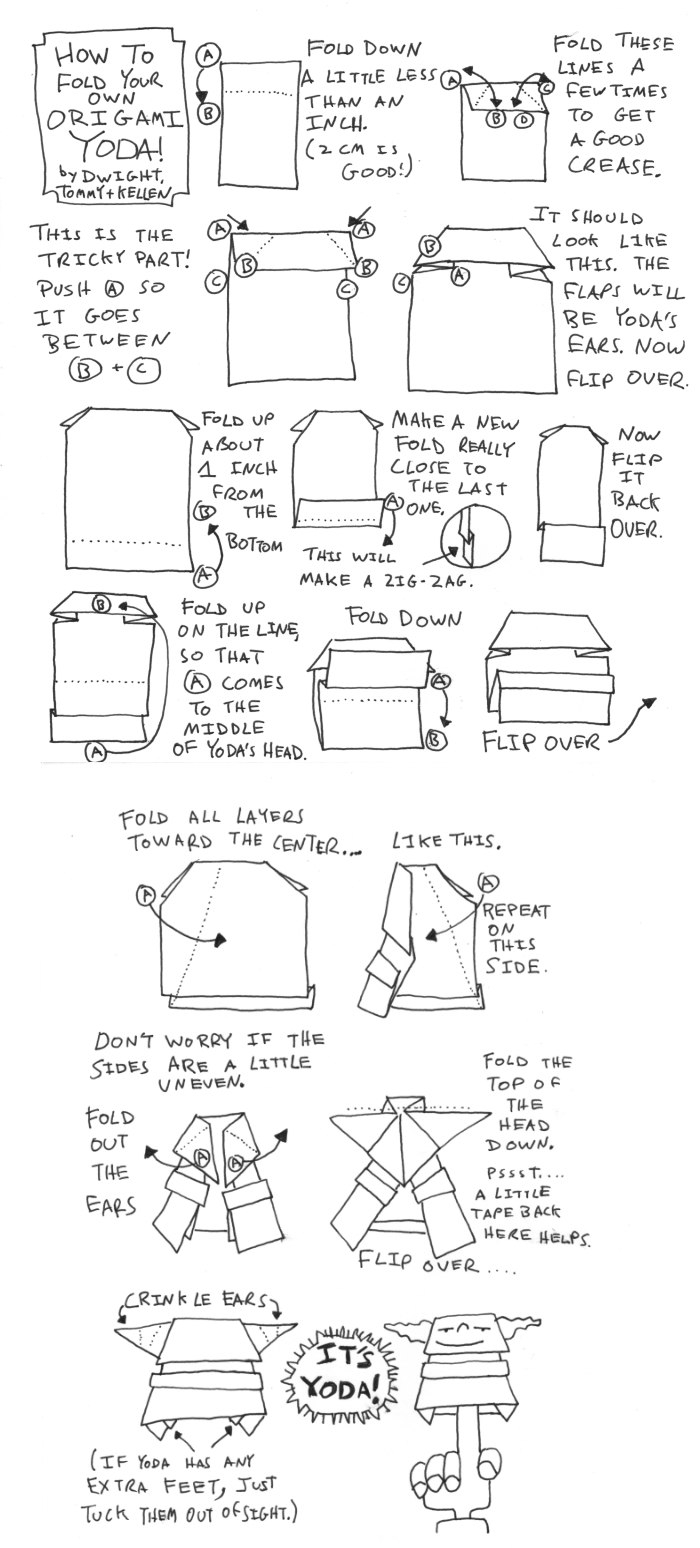
  • Each participant should have time to complete two projects. They can do a third if time permits. Once the projects are complete, we will watch the Scholastic book trailer for The Strange Case of Origami Yoda (http://www.youtube.com/watch?v=gM-JN6D3cAo&feature=related) and a origami Yoda demonstration from the author Tom Anglebrand (http://www.youtube.com/watch?v=LosgVnBDdjw&feature=related) which the children can follow to make their own Yoda. A page of written instructions to make a more complex Yoda is also available from the author’s website http://origamiyoda.files.wordpress.com/2009/10/yodainstructions.jpg). Make copies of these to send home with the participants. 
  • Encourage participants to check out the instructional books or one of the fiction or narrative books that are available or a book on Japan or Japanese art.


Instructional Books:
·         Origami for Everyone: Beginner, Intermediate, Advanced by Didier Boursin
·         Origami by Sally Henry and Trevor Cook
·         Origami:  The Fun and Funky Art of Paper Folding by Trhiranut Boonyadhistarn
·         Origami Zoo:  25 Fun Paper Animal Creations by Paul Jackson and Miri Golan
·         Origami Toys:  That Tumble, Fly, and Spin by Paul Jackson
·         Monster Origami by Duy Nguyen
·         Origami for Fun! By Thiranut Deborah Berry
·         Snap Books Origami Series by Mary Meinking and Chris Alexander
·         Origami Tessellations:  Awe-Inspiring Geometric Designs by Eric Gjerde
·         Ornamental Origami:  Exploring 3D Geometric Designs by Meenakshi Mukerji
·         Unit Polyhedron Origami by Tomoko Fuse
Fiction/narrative books with origami tie-ins:
·         The Pirate Girl’s Treasure:  An Origami Adventure by Peyton Leung (picture book with origami demonstration)
·         The Strange Case of Origami Yoda by Tom Angleberger
·         Darth Paper Strikes Back by Tom Angleberger
·         The Secret of the Fortune Wookiee by Tom Angleberger (release date August 2012)
·         Waiting to Forget by Sheila Kelly Welch
·         Sadako and the Thousand Paper Cranes by Eleanor Coerr
·         1001 Cranes by Naomi Hirahara
·         Little Oh by Laura Krauss Melmed (picture book)
·         The Paper Crane by Molly Bang (picture book)
Books on Japan/Japanese Art and Culture:
·         Several volumes from 952 in nonfiction
·         From Painted Scrolls to Anime:  Literature and the Arts of Japan by Patty Ruland
·         Traditional Crafts from Japan by Florence Temko

References
Sullivan, Michael. Fundamentals of Children’s Services. Chicago: American Library Association, 2005.