Showing posts with label traditional literature. Show all posts

Monday, April 22, 2013

You Read to Me, I'll Read to You by Mary Ann Hoberman

Hoberman, Mary Ann. 2004. You read to me, I'll read to you: very short fairy tales to read together (in which wolves are tamed, trolls are transformed, and peas are triumphant). Ill. by Michael Emberley.  New York: Little, Brown. ISBN 978-0316207447

Part of a series of books by Hoberman that feature poems written to be performed by two readers, this volume features poems based on familiar fairy tales.  Short lines, rhyme, and rhythm are an important to each poem.  The illustrations by Emberley add humor and support to the text.  

The volume contains a table of contents, with each poem titled with the name of the fairy tale.  An author's note discussing the purpose and origin of the concept provides guidance for the performance of the poetry.

Featured poem:

The Three Little Pigs

I'm Big Bad Wolf.
I'm Little Pig.
You're very small.
You're very big.
Bug now I've got you
In my pot.
The water's getting
Very hot.
I'll cook you up
And make a stew.
Why, that's an awful
Thing to do.
Now that's a silly
Thing to say.
You ate my brother
Yesterday.
Why, so I did!
I had forgot.
(This water's getting 
Really hot.)
And on the day before
It's you
Who ate my other
Brother, too.
Did I do that?
That wasn't nice.
(Could you put in 
A little ice?)
They built their houses
In the town.
You huffed and puffed
And blew them down.
Well, they were made
Of straw and sticks
While yours is made
Of good strong bricks.
First I built
My house of bricks,
And then I fooled you
With my tricks.
And now you've got me
In your pot.
This water's really
Really hot!
Say you're sorry
Loud and clear.
I'm sorry.  Let me
Out of here!
Louder!  Clearer!
Give a shout!
I'M SORRY, PIG!
NOW LET ME OUT!
Now do you promise
To be nice?
I promise Pig.
Then here's some ice.
Sit down and cool
Yourself a bit.
I'll read you something
While you sit.
What will you read?
A tale that's true.
A tale about
Both me and you.
Can I read, too?
If you know how.
Of course I do.
Then let's start now.
(Unison)
We'll read Three Little Pigs
Right through
You'll read to me.
I'll read to you.

Since the poem is meant to be performed by two people, I would enlist a second reader and rehearse the poem before presenting to students.  Because the animals are the speakers of the poem, I would use a pig and a wolf puppet to present the poem.

After modeling a performance of the style of poetry contained in the book, I would ask students to team up and present some of the  poems contained within.  Providing costumes, puppets, or props can allow students to create unique performance experiences.  

Saturday, December 8, 2012

Calamity Jack by Shannon and Dean Hale

Bibliographic Information:
Hale, Shannon and Dean Hale. 2010. Calamity Jack. Illustrated by Nathan Hale. New York: Bloomsbury.

Plot summary:
Jack sees himself as a criminal mastermind with more than his share of bad luck.  All of his plans and schemes seem to go awry or have unintended consequences.  In an effort to make his mother proud, he plans to quit his wicked ways after one final score.  When the beanstalk mishap results in the death of a giant, Jack must flee his home.  He returns some time later with his friend Rapunzel to discover that Shyport is under the control of Blunderboar the giant who may be in league with the ant people to keep the city under control.  With the help of Freddie, a journalist and collector of gadgets and Jack's old partner in crime Prudence the pixie, Jack and Rapunzel must put a stop to Blunderboar's reign and save Jack's mother, proving once and for all that Jack can live up to family expectations.

Analysis:
Jack narrates the graphic novel in boxes of text that fill in the gaps of dialogue and drawing, describing the capers of his childhood and his descent into a life of petty crime.  Fantastical creatures and characters from traditional literature appear throughout the story.  In fact, Jack will be known to readers as the folktale character who climbed a beanstalk to steal from a giant.  Rapunzel has had a haircut but keeps her long locks to use as tools or weapons as needed.  The blending of familiar characters into a new and inventive story adds interest.

Visually the story is vivid and full of movement, and the appearance of the characters gives an impression of their nature, attractive heroes and heroines with the bad guys disfigured or misshapen.  The varying sizes of the panels enables the illustrator to show fine details or to convey the size and magnitude of the scenes and characters.

Reviews & Awards:
Junior Library Guild Selection
2011 YALSA Great Graphic Novel
SLJ Best Comic for Kids 2011
Horn Book review: "The swashbuckling plot shines in the graphic-novel format... this steampunk-flavored fairy tale will appeal to boy-, girl-, reluctant- and eager readers alike."
Kirkus Reviews:  "something for everyone... Readers will relish this gleeful mix of fairy tale, adventure and romance."


Connections:

  • Display with other graphic novels that draw from traditional literature including Rapunzel's Revenge, Cinderlla:  the Graphic Novel, and Trickster: Native American Tales:  a Graphic Collection
  • Engage students in creating their own graphic re-tellings of familiar stories.
  • Explore the steampunk elements of the illustrations and make connections to other examples of steampunk motif in books and movies.
  • Other books by the author:
Hale, Shannon. 2003. The goose girl. New York: Bloomsbury.
Hale, Shannon. 2004. Enna burning. New York: Bloomsbury.
Hale, Shannon. 2005. Princess Academy. New York: Bloomsbury
Hale, Shannon. 2006. River secrets. New York: Bloomsbury
Hale, Shannon. 2007. Book of a thousand days. New York: Bloomsbury. 
Hale, Shannon. 2009. Forest born. New York: Bloomsbury.


Saturday, September 29, 2012

Easy Work! An Old Tale retold by Eric A. Kimmel, illustrated by Andrew Glass


Bibliography:
Kimmel, Eric A. 1998. Easy work! an old tale. Ill. by Andrew Glass. New York: Holiday House. ISBN 0823413497

Plot:
Kimmel takes a traditional Norwegian tale of a man and woman switching roles and sets it on America’s frontier. Mr. and Mrs. McTeague travel the Oregon Trail to a new life.  When Mr. McTeague comes home each night worn from his hard work clearing the land for their farm, he is doubtful that Mrs. McTeague’s responsibilities can cause nearly so much fatigue.  Mrs. McTeague’s suggestion that they switch roles for a day results in a predictably humorous disaster as he discovers that Mrs. McTeague’s jobs may not be such “easy work.”

Analysis:
As he describes in an author’s note at the end of the text, Kimmel was inspired to write this story by an anecdote from the life of suffragette Abigail Scott Duniway in which she listens to a farmer boast of the life of ease his wife enjoyed and discovers that the wife is at home chopping firewood. Kimmel found a connection between Mrs. Duniway’s experience and the traditional Norwegian tale “The Husband who Was to Mind the House” and set his version of the tale on Oregon’s frontier. Mrs. McTeague is portrayed in the story as hardworking like the farmer’s wife, patient in face of her husband’s complaining, and forgiving of the mess that he creates while the husband comes across as bumbling, boastful, and inept.

The American setting does not alter the tale much from the original.  Both versions challenge the concept of gender roles and “men’s work” versus “women’s work” in a way that may seem obvious to a modern reader but would have been more revolutionary when the tale originated.

Glass’s illustrations complement the story well especially capturing the comic aspects of the story in vivid colors.  The colloquialisms used in the dialogue by Mr. McTeague connect to the oral tradition of storytelling.

Awards & Reviews: 
From Booklist: “Kimmel’s version of a story that has become a staple of feminist folktale collections will be a cheery alternative to, say, P. C. Asbjornsen and J. E. Moe’s The Man Who Kept House (1992) and a good replacement for Wanda Gag’s out-of-print Gone Is Gone.”

School Library Journal review: “ . . . Easy Work would make an enjoyable addition to most collections.”

Connections:
  • Use in a storytime with farm stories. 
  • Use in conjunction with other texts both fiction and nonfiction about the Oregon Trail (especially Apples to Oregon by Deborah Hopkinson, illustrated by Nancy Carpenter)
  • Share the author note that details Kimmel’s inspiration for the story and make connections to women’s rights/suffrage.
  • For older children, this story would be good to compare with its other versions and variants:
Asbjørnsen, Peter Christen, and Jørgen Engebretsen Moe. 1963. East of the sun and west of the moon and other tales. New York: Macmillan. 

Gág, Wanda. 1935. Gone is gone, or, The story of a man who wanted to do housework. New York: Coward-McCann, Inc.

Goode, Diane. 1992. Diane Goode's book of silly stories & songs. New York: Dutton Children's Books. ISBN 0525449671

Gurvin, Abe. 1968. The husband who was to mind the house. New York: Young Readers Press.

Littledale, Freya, and Molly Delaney. 1987. The farmer in the soup: retold from the Norse Tale, the husband who was to mind the house. New York: Scholastic Inc. ISBN 0590401947

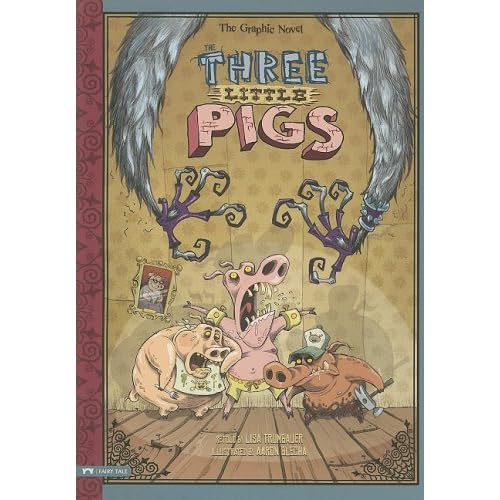
The Three Little Pigs: The Graphic Novel Retold by Lisa Trumbauer


Bibliography:
Trumbauer, Lisa. 2009. The three little pigs: the graphic novel. Ill. by Aaron Blecha. Minneapolis: Stone Arch Books. ISBN 1434211959


Plot:
The plot of this graphic novel retelling of The Three Little Pigs stays true to the familiar premise of the tale.  The three pigs are sent out into the world to make their own way by the mother pig and construct dwellings of straw, sticks, and bricks.  When the big bad wolf visits the first two pigs he is easily able to huff and puff their houses away and capture the pigs.  When he is unsuccessful in blowing down the brick house, he invites the third pig on three different outings, but the wily pig is able to get home safely from each one. 

Fed up, the wolf climbs down the chimney into the kettle full of boiling water, scalding his tail and sending him running away.  The third pig rescues his brothers who have not yet been eaten and helps them build sturdier houses for themselves.  It seems as though the brothers will live happily after, but the book ends with the wolf cooling his tail, growing hungrier and plotting his revenge.

Analysis:
The story is told through a comic book/graphic novel format with an overall dark feeling to the artwork.  The artwork lacks the cartoon cuteness of many picture retellings with very messy piggish pigs and a sinister, toothy wolf.  The style may appeal to older audiences, but this selection still offers a faithful retelling of the traditional tale that is capable of drawing in younger readers who are new to the story as well.  The panels contain enough dialogue and transitional text to develop the characters, but the momentum of the story relies, as it should for this format, on the graphic elements.

The plot sequence involving the wolf attempting to lure the third pig out of his home to pick turnips and apples and attend the fair is one that is often left out of picture book retellings and may be unexpected or new to readers who are familiar with this tale, but it serves to further portray the third pig brother as a clever and resourceful adversary for the wolf.  The supposedly weaker animal who outwits the stronger villain is a common element in many folktales, and Trumbauer is able to develop these characters to fit the archetype.

The end of the book contains several interesting extras including a brief history of the three pigs folktale, discussion questions, writing prompts, and an internet site to enrich the book experience.  These elements offer both teachers and individual readers ways to extend the reading experience.

Awards & Reviews:
15 Best Illustrated Children’s Books 2009 honoree by Ashbooks Book Community
School Library Journal review: “The wolf is particularly menacing and its curved claws and glowing green eyes will remain in children's thoughts at the end of the tale as it lies in wait.”

Connections:
  • Compare to other Three Little Pig variants and versions. This book will lend itself to conversations about artistic style because of the distinct comic book elements and creepy visuals.
  • Explore the book extensions offered in the book such as discussion questions and writing prompts. 
  • Encourage children to create comic books/graphic novels of other familiar stories. 
  • More folk tales in graphic novel format:

Dahl, Michael, and Luke Feldman. 2009. Beauty and the beast: the graphic novel. Mankato, Minn: Stone Arch Books.  ISBN 143420765X
Hoena, B. A., and Ricardo Tercio. 2009. Jack and the beanstalk: the graphic novel. Mankato, Minn: Stone Arch Books. ISBN 1434207668
Powell, Martin, and Erik Valdez y Alanis. 2009. Rumpelstiltskin: the graphic novel. Mankato, Minn: Stone Arch Books.  ISBN 1434207684

Friday, September 28, 2012

Joseph Had a Little Overcoat by Simms Taback


Bibliography:
Taback, Simms. 1999. Joseph had a little overcoat. New York: Viking.  ISBN 0670878553


Plot:
Based on a traditional Yiddish folk song, Taback’s tale follows the titular character as he takes his old and frayed overcoat and repurposes it into increasingly smaller garments as each one wears down.  In the end, Joseph loses the button, the smallest portion of the overcoat he has left, but he takes the nothing he has left and creates the book.

Analysis:
The text is simple and repetitive in structure as Joseph goes through smaller and smaller fragments of his overcoat, but the collage illustrations support it beautifully with bright colors and humorous and subtle details.  The book also incorporates die-cut holes in the pages that provide clues about what garment Joseph will create next.  This clever device is itself a type of recycling, utilizing the previous illustration to make the next and reinforcing Joseph’s actions in the story.  The illustrations also support the cultural roots of the source material, from the dress style of the characters to the Yiddish phrases in the background.

The cumulative nature of this folk tale will help younger readers to engage in the story by anticipating and predicting what comes next.  This pattern of refrain will be a familiar storytelling device to most readers which will likely increase its appeal.

Awards & Reviews:
2000 Caldecott Medal
2000 ALA Notable Children’s Book
From Publisher’s Weekly: “With its effective repetition and an abundance of visual humor, this is tailor-made for reading aloud.”
School Library Journal review: “A book bursting at the seams with ingenuity and creative spirit.”
Booklist: “Taback's mixed-media and collage illustrations are alive with warmth, humor, and humanity.”

Connections:
·        Use in a storytime about clothing or getting dressed.
·        Since the story is based on a song, teach the children the English version included in the book.  Try to find a recording of the Yiddish version as well.
·        Use the book to introduce a discussion of reuse or recycling or for a craft program that repurposes used paper or fabric.
·        Other picture books that use die-cut pages to enhance the story or illustrations:
Carle, Eric. 1987. The very hungry caterpillar. [New York]: Philomel Books. ISBN 0399208534
Emberley, Ed. 1992. Go away, big green monster! Boston: Little, Brown. ISBN 0316236535
MacDonald, Suse. 2009. Shape by shape. New York: Little Simon. ISBN 1416971475
Taback, Simms. 1997. There was an old lady who swallowed a fly. New York: Viking. ISBN 0670869392