Figuring out how to have the book audio clip and the music playing at the same time is the greatest achievement of my life.
Saturday, October 20, 2012
Why We Broke Up by Daniel Handler
My second-ever attempt at book trailer creation . . .
Figuring out how to have the book audio clip and the music playing at the same time is the greatest achievement of my life.
Figuring out how to have the book audio clip and the music playing at the same time is the greatest achievement of my life.

Saturday, October 13, 2012
We Are America by Walter Dean Myers
Myers, Walter Dean. 2011. We
are America: a tribute from the heart. Ill. by Christopher Myers. New York,
NY: HarperCollins Children's Books. ISBN 060523085


Summary:
In free verse enhanced by quotations from American history and mural-style illustrations, Myers creates a portrait of America from its native people to the children of the future with allusion to so many events, people, and ideas that have shaped the nation.
Analysis:
Myers manages in a few lines to chronicle several hundred years of history while capturing the spirit of freedom and striving that have always defined success in America. The poem’s words, though powerful and vivid on their own, are difficult to separate from Christopher Myers’s artwork. Historical figures and iconic images from history appear alongside young, colorful, hopeful faces of Americans in harmony with the poem. The imagery of the poem is strong, using metaphor and other poetic device to convey powerful emotion.
Myers manages in a few lines to chronicle several hundred years of history while capturing the spirit of freedom and striving that have always defined success in America. The poem’s words, though powerful and vivid on their own, are difficult to separate from Christopher Myers’s artwork. Historical figures and iconic images from history appear alongside young, colorful, hopeful faces of Americans in harmony with the poem. The imagery of the poem is strong, using metaphor and other poetic device to convey powerful emotion.
Awards & Reviews:
NCTE Notable Poetry List 2012
CYBILS Award Finalist 2011
Kirkus Reviews: "The poetry and the paintings will be an excellent jumping-off
point for discussions."
From Publisher's Weekly: " . . . few will be unmoved by this stirring and provocative
collaboration."
Connections:
- Share the author notes from the book and show students
the video (below and at http://www.youtube.com/watch?v=oDQXjG0hjLQ) of
the poet and illustrator discussing the inspiration for the poems.
- Explore the companion website Who Is America? (http://www.who-is-america.com/)
and encourage students to create video responses for the site.
- Use the historical events alluded to in the poem or
depicted in the illustrations as well as the quotations to introduce
history lessons/discussions.
- More poetry/art by Walter Dean Myers & Christopher
Myers:
Myers, Walter Dean. 1997. Harlem:
a poem. Ill. by Christopher Myers. New York: Scholastic Press.
ISBN 0590543407
Myers, Walter Dean. 2006. Jazz.
Ill. by Christopher Myers. New York: Holiday House. ISBN 0823415457
- America-inspired poetry:
Borden, Louise. 2002. America
is--. Ill. by Stacey Schuett. New York: Margaret K. McElderry
Books. ISBN 0689839006
Hopkins, Lee Bennett.
2000. My America: a poetry atlas of the United States. Ill.
by Stephen Alcorn. New York: Simon & Schuster Books for Young
Readers. ISBN 0689812477
Panzer, Nora. 1994. Celebrate
America: in poetry and art. New York: Hyperion Books for Children.
ISBN 1562826646
What My Mother Doesn't Know by Sonya Sones
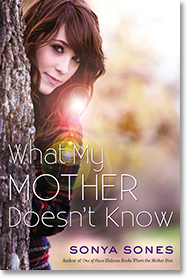 Sones, Sonya. 2001. What my mother doesn't know. New York: Simon & Schuster Books for Young Readers. ISBN 0689841140
Summary:
Written in free verse, the novel is narrated by fourteen-year-old Sophie who is navigating life, love, and high school with varying degrees of success. In short titled poems, readers learn about Sophie’s fighting parents, best friends, and the birth and slow demise of her relationship with Dylan. A mystery encounter with a masked man at the Halloween dance fill her with questions and longing, and when his identity is eventually revealed, Sophie must make some mature decisions about her life, identity, and popularity.
Sophie’s voice is authentic and emotional, conveying the confusion, passion, and angst of adolescence without shying away from sensitive topics. The lines of most of the poems are short but full of imagery and description. Repetition is used for emphasis in several poems, most notably and effectively in a poem describing the after-effects of a fight with her mother entitled “I Hate Her” in which she details a list of things she hates about her mother most of which have nothing to do with their fight. The concise but descriptive language manages to convey both the action of the narrative and the full range of emotions in a unique way which will connect with teen readers while also resonating with adults who can still remember the elation and tragedy of growing up.
ALA Best Book for Young Adults
(2002)
ALA Top Ten Quick Pick for
Reluctant Young Adult Readers (2002)
International Reading Association Young Adults' Choice
(2003)
Winner of the Iowa Teen Book Award (2005–2006)
| |
Starred review & Editor's Choice, Booklist: "The poetry is never pretentious or difficult; on the contrary, the very short, sometimes rhythmic lines make each page fly."
Starred review, Kirkus Reviews: "A verse experience that will leave readers sighing with recognition and satisfaction."
Connections:
- Incorporate into a Banned Books Week display, discussion, or Read-Out.
- Introduce to young writers' group to encourage journaling and authentic voice
- Make connections to the art in the book including Renoit and the Museum of Bad Art (museumofbadart.org)
- Connect readers of the book with the author's website (sonyasones.com) for background information, writing advice, and blog.
- Other novels in verse for young adults:
Herrera, Juan Felipe. 1999. CrashBoomLove: a novel in
verse. Albuquerque: University of New Mexico Press. ISBN 0826321135
Sones, Sonya. 2004. One of those hideous books where
the mother dies. New York: Simon & Schuster Books for Young Readers.
ISBN 0689858205
Sones, Sonya. 1999. Stop pretending: what happened
when my big sister went crazy. New York: HarperCollins Publishers.
ISBN 0060283874
Sones, Sonya. 2007. What my girlfriend doesn't know.
New York: Simon & Schuster Books for Young Readers. ISBN 0689876025
Tregay, Sarah. 2012. Love & leftovers: a novel in
verse. New York, NY: Katherine Tegen Books. ISBN 0062023586
Friday, October 12, 2012
Autumnblings by Douglas Florian
 Florian, Douglas. 2003. Autumnblings: poems & paintings. New York: Greenwillow Books. ISBN 0060092785
Summary:
In this topical collection of poems, Florian explores the sights and sounds of the changing of the season from summer to autumn to the encroachment of winter. Accompanied by watercolor illustrations by the poet, the twenty-nine poems tumble through the distinctive ideas and images of fall: apples, pumpkins, leaves, holidays, etc.
Analysis:
The rhymes, repetitions, and rhythms of the poems are simple and appealing. Florian uses form and shape of the words and lines themselves as well as the illustrations to visualize the meanings of the poems. The word play that features in so many of the poems adds whimsy and playfulness. The poet creates puns and invents new words like autumn-atically, fallicopters, owlphabet, and hi-bear-nate to capture those things that are so unique to this season. Although the topics, rhymes, and poetic devices vary from poem to poem, the collection is drawn together by the overall theme as well as style, artwork, and a sense of fun.
Awards & Reviews:
From School Library Journal: "A natural for use in classrooms and library programs, and accessible to newly independent readers, these poems will delight youngsters."
A Booklist review: "Florian presents a winsome series of poems about fall, with the punning theme of the title carried throughout."
Connections:
- Use selections in storytimes for younger children with an autumnal theme.
- Have older students visit Florian's website www.douglasflorian.com or his poetry blog www.floriancafe.blogspot.com to learn more about the author and see more of his artwork.
- Introduce lessons about science and seasons with selected poems.
- Encourage children to write and illustrate their own seasonal poetry.
- Other topical poetry collections/anthologies about seasons:
Florian, Douglas.
2006. Handsprings: poems & paintings. New York: Greenwillow
Books. ISBN 0060092807
Florian, Douglas. 2002. Summersaults: poems &
paintings. New York: Greenwillow Books.ISBN 0060292679
Florian, Douglas. 1999. Winter eyes: poems & paintings.
New York: Greenwillow Books. ISBN 0688164587
Rogasky, Barbara. 2001. Leaf by leaf: autumn poems.
Ill. by Marc Tauss. New York: Scholastic Press. ISBN 0590253476
Sidman, Joyce. 2009. Red sings from treetops: a year
in colors. Ill. by Pamela Zagarenski. Boston: Houghton Mifflin
Books for Children. ISBN 0547014945
Yolen, Jane. 1986. Ring of earth: a child's book of
seasons. Ill. by John Wallner. San Diego: Harcourt Brace
Jovanovich. ISBN 0152671404
Zolotow, Charlotte. 2002. Seasons: a book of poems.
Ill. by Erik Blegvad. New York: HarperCollins. ISBN 0060266988
Saturday, September 29, 2012
Easy Work! An Old Tale retold by Eric A. Kimmel, illustrated by Andrew Glass
Bibliography:
 Kimmel, Eric A. 1998. Easy work! an old tale.
Ill. by Andrew Glass. New York: Holiday House. ISBN 0823413497
Kimmel, Eric A. 1998. Easy work! an old tale.
Ill. by Andrew Glass. New York: Holiday House. ISBN 0823413497
Plot:
Kimmel takes
a traditional Norwegian tale of a man and woman switching roles and sets it on
America’s frontier. Mr. and Mrs. McTeague travel the Oregon Trail to a new life. When Mr. McTeague comes home each night worn from his hard work clearing the land for
their farm, he is doubtful that Mrs. McTeague’s responsibilities can cause
nearly so much fatigue. Mrs. McTeague’s
suggestion that they switch roles for a day results in a predictably humorous
disaster as he discovers that Mrs. McTeague’s jobs may not be such “easy work.”
Analysis:
As he
describes in an author’s note at the end of the text, Kimmel was inspired to write
this story by an anecdote from the life of suffragette Abigail Scott Duniway in
which she listens to a farmer boast of the life of ease his wife enjoyed and
discovers that the wife is at home chopping firewood. Kimmel found a connection
between Mrs. Duniway’s experience and the traditional Norwegian tale “The
Husband who Was to Mind the House” and set his version of the tale on Oregon’s
frontier. Mrs. McTeague is portrayed in the story as hardworking like the
farmer’s wife, patient in face of her husband’s complaining, and forgiving of
the mess that he creates while the husband comes across as bumbling, boastful,
and inept.
The American
setting does not alter the tale much from the original. Both versions challenge the concept of gender
roles and “men’s work” versus “women’s work” in a way that may seem obvious to a
modern reader but would have been more revolutionary when the tale originated.
Glass’s
illustrations complement the story well especially capturing the comic aspects of
the story in vivid colors. The colloquialisms
used in the dialogue by Mr. McTeague connect to the oral tradition of
storytelling.
Awards &
Reviews:
From Booklist: “Kimmel’s version of a story that has become a
staple of feminist folktale collections will be a cheery alternative to, say,
P. C. Asbjornsen and J. E. Moe’s The Man Who Kept House (1992) and a
good replacement for Wanda Gag’s out-of-print Gone Is Gone.”
School
Library Journal review: “ . . . Easy Work would make an
enjoyable addition to most collections.”
Connections:
- Use in a storytime with farm stories.
- Use in conjunction with other texts both fiction and
nonfiction about the Oregon Trail (especially Apples to Oregon by Deborah
Hopkinson, illustrated by Nancy Carpenter)
- Share the author note that details Kimmel’s
inspiration for the story and make connections to women’s rights/suffrage.
- For older children, this story would be good to compare with its other versions and variants:
Gág, Wanda. 1935. Gone is gone, or, The story of a man who wanted to do housework. New York: Coward-McCann, Inc.
Goode, Diane. 1992. Diane Goode's book of silly stories & songs. New York: Dutton Children's Books. ISBN 0525449671
Gurvin, Abe. 1968. The husband who was to mind the house. New York: Young Readers Press.
Littledale, Freya, and Molly Delaney. 1987. The farmer in the soup: retold from the Norse Tale, the husband who was to mind the house. New York: Scholastic Inc. ISBN 0590401947
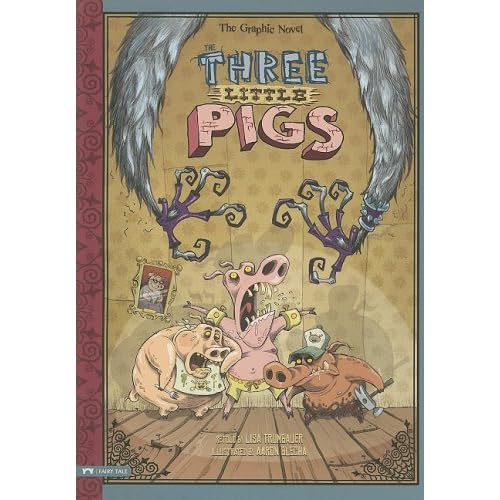
The Three Little Pigs: The Graphic Novel Retold by Lisa Trumbauer
Bibliography:
Trumbauer, Lisa. 2009. The three little pigs: the graphic novel. Ill. by Aaron Blecha. Minneapolis: Stone Arch Books. ISBN 1434211959
Plot:
The
plot of this graphic novel retelling of The
Three Little Pigs stays true to the familiar premise of the tale. The three pigs are sent out into the world to
make their own way by the mother pig and construct dwellings of straw, sticks,
and bricks. When the big bad wolf visits
the first two pigs he is easily able to huff and puff their houses away and
capture the pigs. When he is
unsuccessful in blowing down the brick house, he invites the third pig on three
different outings, but the wily pig is able to get home safely from each
one.
Fed
up, the wolf climbs down the chimney into the kettle full of boiling water,
scalding his tail and sending him running away.
The third pig rescues his brothers who have not yet been eaten and helps
them build sturdier houses for themselves.
It seems as though the brothers will live happily after, but the book
ends with the wolf cooling his tail, growing hungrier and plotting his revenge.
Analysis:
The
story is told through a comic book/graphic novel format with an overall dark
feeling to the artwork. The artwork
lacks the cartoon cuteness of many picture retellings with very messy piggish
pigs and a sinister, toothy wolf. The
style may appeal to older audiences, but this selection still offers a faithful
retelling of the traditional tale that is capable of drawing in younger readers
who are new to the story as well. The
panels contain enough dialogue and transitional text to develop the characters,
but the momentum of the story relies, as it should for this format, on the
graphic elements.
The
plot sequence involving the wolf attempting to lure the third pig out of his
home to pick turnips and apples and attend the fair is one that is often left
out of picture book retellings and may be unexpected or new to readers who are
familiar with this tale, but it serves to further portray the third pig brother
as a clever and resourceful adversary for the wolf. The supposedly weaker animal who outwits the
stronger villain is a common element in many folktales, and Trumbauer is able
to develop these characters to fit the archetype.
The
end of the book contains several interesting extras including a brief history
of the three pigs folktale, discussion questions, writing prompts, and an
internet site to enrich the book experience.
These elements offer both teachers and individual readers ways to extend the
reading experience.
Awards & Reviews:
15
Best Illustrated Children’s Books 2009 honoree by Ashbooks Book Community
School Library Journal review: “The wolf is particularly
menacing and its curved claws and glowing green eyes will remain in children's
thoughts at the end of the tale as it lies in wait.”
Connections:
- Compare to other Three Little Pig variants and versions. This book will lend itself to conversations about artistic style because of the distinct comic book elements and creepy visuals.
- Explore the book extensions offered in the book such as discussion questions and writing prompts.
- Encourage children to create comic books/graphic novels of other familiar stories.
- More folk tales in graphic novel format:
Dahl, Michael, and Luke Feldman. 2009. Beauty
and the beast: the graphic novel. Mankato, Minn: Stone Arch Books. ISBN 143420765X
Hoena, B. A., and Ricardo Tercio.
2009. Jack and the beanstalk: the graphic novel. Mankato, Minn:
Stone Arch Books. ISBN 1434207668
Powell, Martin, and Erik Valdez y
Alanis. 2009. Rumpelstiltskin: the graphic novel. Mankato, Minn:
Stone Arch Books. ISBN 1434207684
Friday, September 28, 2012
Joseph Had a Little Overcoat by Simms Taback
Bibliography:
Taback, Simms. 1999. Joseph
had a little overcoat. New York: Viking.
ISBN 0670878553
Plot:
Based
on a traditional Yiddish folk song, Taback’s tale follows the titular character
as he takes his old and frayed overcoat and repurposes it into increasingly
smaller garments as each one wears down.
In the end, Joseph loses the button, the smallest portion of the
overcoat he has left, but he takes the nothing he has left and creates the
book.
Analysis:
The
text is simple and repetitive in structure as Joseph goes through smaller and
smaller fragments of his overcoat, but the collage illustrations support it
beautifully with bright colors and humorous and subtle details. The book also incorporates die-cut holes in
the pages that provide clues about what garment Joseph will create next. This clever device is itself a type of
recycling, utilizing the previous illustration to make the next and reinforcing
Joseph’s actions in the story. The
illustrations also support the cultural roots of the source material, from the
dress style of the characters to the Yiddish phrases in the background.
The
cumulative nature of this folk tale will help younger readers to engage in the
story by anticipating and predicting what comes next. This pattern of refrain will be a familiar
storytelling device to most readers which will likely increase its appeal.
Awards & Reviews:
2000
Caldecott Medal
2000
ALA Notable Children’s Book
From
Publisher’s Weekly: “With its
effective repetition and an abundance of visual humor, this is tailor-made for
reading aloud.”
School Library Journal review: “A book bursting at the seams
with ingenuity and creative spirit.”
Booklist: “Taback's mixed-media and collage
illustrations are alive with warmth, humor, and humanity.”
Connections:
·
Use
in a storytime about clothing or getting dressed.
·
Since
the story is based on a song, teach the children the English version included
in the book. Try to find a recording of
the Yiddish version as well.
·
Use
the book to introduce a discussion of reuse or recycling or for a craft program
that repurposes used paper or fabric.
·
Other
picture books that use die-cut pages to enhance the story or illustrations:
Carle, Eric. 1987. The very
hungry caterpillar. [New York]: Philomel Books. ISBN 0399208534
Emberley, Ed. 1992. Go away,
big green monster! Boston: Little, Brown. ISBN 0316236535
MacDonald, Suse. 2009. Shape
by shape. New York: Little Simon. ISBN 1416971475
Taback, Simms. 1997. There was
an old lady who swallowed a fly. New York: Viking. ISBN 0670869392
Subscribe to:
Posts (Atom)