Monday, March 4, 2013

Things Left Unsaid by Stephanie Hemphill


Hemphill, Stephanie. 2005. Things left unsaid : a novel in poems. New York: Hyperion. ISBN 9780786818501

In her debut novel, Hemphill tells the story of high-school junior Sarah, a model student and daughter, who begins to question her life and decisions.  When she is befriended by Robin, a rebellious classmate, Sarah is drawn to the danger and dark glamour of a new life so unlike her old one.  In the end, Robin's self-destructive lifestyle helps Sarah to realize the danger of blindly following, and she must begin to find her own identity.

The novel is told entirely in titled, free verse poems.  Many can stand alone with interest and meaning outside the context of the novel.  Sarah, as the speaker of all the poems, is honest and vulnerable in depicting her confusion and questioning of life.  The poems contain some narrative elements and dialogue, but many are simply descriptive of Sarah's actions and reactions to the events going on around her.  The language is vivid and descriptive, and the poems convey a strong rhythm.

Teens, especially girls, will be drawn to the clear writing and events and emotions depicted in the novel.  The characters are realistic and representative of several teenage archetypes.  The themes of identity, peer pressure, and friendship are especially relevant to teen audiences.  Hemphill does not shy away from sensitive topics, addressing eating disorders, suicide, alcoholism, and abusive parents with honesty and understanding.

This book was awarded the 2006 Myra Cohn Livingston Award for Excellence in Poetry by the Children's Literature Council of Southern California.

Feature poem:

Under This Skin

I itch,
not pathologically,
but like I'll feel great relief
if I untie my wool scarf

and let my neck bathe
in sunlight.
I'm ready to take
something off

shed the heavy layers.

In the novel, this poem describes Sarah coming out of a time of worry and depression after the attempted suicide of her friend.  She is coming to terms with her own sense of self and getting ready to start living her life on her own terms.  It is a pivotal point in the plot where readers see Sarah start to take control of her life.

With or without the context of the novel, this poems is evocative of throwing off old ways or feelings that weigh down or hold back.  The imagery lends itself to self-expression and new freedom.  This poem would be an excellent introduction to getting students to engage in personal or creative writing such as poetry.  Every year my library holds a teen poetry performance competition, and we try to share poems with them that will inspire them to find or write poems that express their emotions and that also inspire them to speak, read, or recite.  This would be an excellent poem to use an example or inspiration for that purpose.


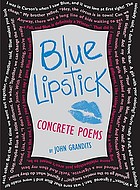
Blue Lipstick: Concrete Poems by John Grandits

Grandits, John. 2007. Blue lipstick: concrete poems. New York: Clarion Books. ISBN 9780618568604

Concrete poems use the shape of the words and lines to convey meaning.  In Blue Lipstick, John Grandits revisits the characters from his earlier book Technically It's Not My Fault as well as the concrete poetry style to tell the story of fifteen-year-old Jessie.  The title poem on the book's cover introduces us to the cast of characters:  Jessie, her parents, her little brother Robert, and best friend Lisa.  We also get a glimpse into Jessie's personality as a girl who likes to be different and take risks.  These relationships and traits are further explored in the rest of the poems in the volume.  

Many of the meanings or themes are enhanced by the forms of the poems themselves, and the visual impact of the poems are as striking as the honest portrayal of teenage life.  Jessie, as the speaker of all the poems, is articulate and creative using figurative language and strong images to convey a wide range of emotions.

The wide range of topics with varying levels of seriousness and angst depict a realistic and relatable portrait of a teenage girl who is by turns angst-ridden, insecure, and insightful.  In her quest to be an individual, Jessie reveals that she is just like everyone else.  Teen readers, especially girls, will relate to the emotions and situations in the poems, and adult readers will also find themselves drawn to the collection.

The poems can mostly stand alone but are enhanced by the unified collection which is arranged in a rough chronology with some poems making references back to previous ones.  The relationships between Jessie and her parents and brother can especially be seen to develop across several poems.  The volume is book-ended by two versions of a poem called "The Wall" that describes the people who are on Jessie's side versus those who are on the opposing side of the wall.  The second version of this poem acknowledges that some people, once considered enemies, have come to Jessie's side of the wall.  

In this collection, Grandits uses his design background to give the poems shape and additional meaning.  The book received a starred review from School Library Journal as well a appearing on SLJ's Best Books of the Year list.  It is an ALA Notable Book and an ALA Quick Pick for Young Adults.  It won a Lee Bennett Hopkins Poetry Honor Award.

Featured poem: 
(The poem is written on black lines surrounding blocks of color in the manner of the art described in the painting.  There are no line breaks in the poem because of its design.)

Mondrian

Dad and I went to the Art Institute.
There was a show of work by Mondrian, and the guy totally rocks!
He did these paintings with just boxes and lines,
and he only used black and yellow and blue and red. 
I mean, he didn't mix his colors at all.
It was so simple and so elegant. 
I said, "I wish I could do that when I grow up--
make ultra-cool radical art."
Dad said, "It's not easy 
to be creative." 
And I thought to myself, "You wouldn't believe how creative
I have to be just to get through the day."
He said, "It's tough being an artist.
You've got to struggle for years.
People often misunderstand your work.
You've got to be thick-skinned because critics can be cruel.
You don't have any money.  And in many ways,
you're really alone."
And I said,
"It sounds like high school."

This poem would be a fun introduction into the art of Piet Mondrian.  After sharing the poem, students could explore his work through the Museum of Modern Art website (http://www.moma.org/collection/artist.php?artist_id=4057).  In an art class, students could also be encouraged to create their own paintings or art pieces showing the influence of Cubism.

Aside from the art connection, the comparison of an artist's life to that of a high school student could lead to a discussion of other occupations or life situations that might also correlate to aspects of teenage life.

The President's Stuck in the Bathtub: Poems about the Presidents by Susan Katz

Katz, Susan. 2012. The president's stuck in the bathtub: poems about the presidents. Ill. by Robert Neubecker. Boston: Clarion Books. ISBN 9780547182216

In forty-three poems, each President of the United States is acknowledged and celebrated for some distinct aspect of his life or presidency.  Although Grover Cleveland is counted as two Presidents because of his nonconsecutive term, he only gets one poem here.  Katz focuses on the more whimsical and lighthearted stories and characteristics of the nation's leaders and provides a few sentences accompanying each poem that give more information on the poem's topic.  The simple cartoonish illustrations by Neubecker add to the humor and playfulness of the poems.

Nearly all of the poems contain some sort of rhyme and occasional approximate rhyme.  Unusual word choices and figurative language also add to the impact of the poems.  One poem particularly that describes Warren G. Harding's alliterative oratory employs impressive alliteration very effectively.  Lincoln's poem, about his trademark stovepipe hat, is a concrete poem with the text set in the shape of the hat.

Many of the poems are narratives describing a particular event.  As this style of poetry has been found to be popular with students, this feature will make the overall book more appealing to young readers.  The variety of topics from Presidential nicknames, pets, and physical oddities to the more noteworthy achievements grants readers a glimpse into the lives of men who have played a fascinating part in American history.  The poems are informative in presenting an overall picture of the lives of the Presidents but also underline the humanity of the larger-than-life characters, allowing readers to find common ground with these famous men.

The poems are presented in chronological order by President, and Katz has maintained a consistent tone throughout, informing, sparking interest, and amusing through vivid and engaging language and careful selection of topics.  All the poems are new and original to this collection.  Each poem and accompanying facts and illustration get their own page or spread.  The table of contents provides access points by poem name as well as by President, and the book ends with a list of additional information about the Presidents including birth and death dates, a quotation, nickname, and one distinctive fact.

Featured poem:

Overdue Mail (Zachary Taylor, 1849-50)

The Whigs have nominated you
for president,
the letter sent
to Zachary Taylor said.
but the Whigs
mailed it
                  postage due.

Taylor didn't want to spend
ten cents,
so he refused that mail,
dispatched it
back to the dead
letter office.
                  There it sat.

After waiting 
for quite some time,
the Whigs decided to invest
a dime
for a second letter,
postage paid.
                  That worked better.

Taylor happily agreed
and led the Whigs
to victory,
the only man in either camp
who won
the presidency
                  by a stamp.

Before or after reading the poem, I might discuss methods of long distance communication with students:  phone calls, text messages, video chat, email, snail mail, etc. and how the avenues available today were not always accessible.  As so much communication is done through more immediate electronic means, the idea of sending a letter and waiting for a response may be new or unusual to students.

This poem could easily fit into a lesson about the historical time period of Taylor's life or the method of mail delivery in 19th century America, but I would probably use it in a writing lesson as a jumping off point to have students write their own letters to the President, a fun way to learn about the form and parts of a letter, addressing an envelope, and most importantly, not forgetting the stamp.


Monday, February 4, 2013

Birmingham, 1963

Weatherford, Carole Boston. 2007. Birmingham, 1963. Honesdale, Pa: Wordsong. ISBN 978-1-59078-440-2

In free verse poems accompanied by historic photos, Carole Boston Weatherford, through the voice of a fictional child speaker, recounts the bombing of a church in Birmingham, Alabama that claimed the lives of four young girls.  The book ends with four in memoriam poems for the four victims of the bombing.  

The poet uses a refrain of sorts "the year I turned ten" for the early poems that set the background for the events, and "the day I turned ten" to introduce the poems that describe the day of the bombing.  Names or lines from various traditional spiritual songs are interspersed throughout the poems, referencing the songs that are synonymous with the African-American community and the Civil Rights movement.  Sense imagery is used to convey the sights, sounds, and emotions as they would have appeared, sounded or felt to a child rather than an adult.  The poems are emotional in a way that will resonate with both adults and children and convey a sense of the tragedy, but despite the serious subject content are not overwhelmingly sad or manipulative.  The memorial poems about the four girls honor lives that were too brief.

Although the book has no table of contents or index, a note from the poet as well as annotations about the photographs provide a historical context for the poems.  The poems are not named individually which also makes them flow together as one long work.

Featured poem:

The day I turned ten,
I saw blood spilled on holy ground
And my daddy cry for the very first time.
What had those girls done to deserve this?

At supper, no one had much appetite.
Afterwards, Mama washed and I dried dishes
While she hummed "Nobody Knows the Trouble I Seen."

Although the poems describe events that take place elsewhere, most students in Little Rock are well-versed in the history of segregation and the Civil Rights movement because of the desegregation of Central High School in 1957.  Sharing this poem could lead to a discussion of what the students already know about the history of their own city and an extension of that knowledge to the efforts and movements in other cities during that era.

I Am the Book

Hopkins, Lee Bennett. 2011. I am the book: poems. Ill. by Yayo. New York: Holiday House. ISBN 978-0-8234-2119-0

This collection of poems selected by Lee Bennett Hopkins all center around the theme of books and reading. The thirteen poems, including one by Hopkins himself, demonstrate the broad gateway to learning and escapism that books provide readers.

The poems employ various devices to convey the richness of language and meaning.  Many employ rhythm or rhyme, and several use personification, making the book as active a participant in the action as the readers described in the poems.  In some cases, as with the titular poem the book is the speaker of the poem.  Though each poem in the book is distinct and meaningful standing alone, the selections blend together very effectively to create a cohesive collection.

Each of the short but meaningful poems contained in this collection are presented on a two-page spread and are accompanied by whimsical painted illustrations by Yayo that support and add meaning and interest to the poems.  Images of books are cleverly worked into the illustrations as boats, oceans, popsicles, and treasure chests among other things to signify the roles of the book in the lives of readers.  The table of contents, which lists each poems and author, provides access points into the text.

 At book's end, the reader is provided with short blurbs about each of the poets whose work is included in the collection.  Most of the poets are well-known contemporary poets, who have won awards and published works in various anthologies or in their own collections such as Karla Kuskin and Jane Yolen.  The book contains one poem by poet Jill Corcoran whose work had not previously appeared in a published anthology.  Most of the poems appear to have been written or copyrighted the same year as the book's publication, but some of the selections are older and have been previously published such as Karen B. Winnick's "Quiet Morning" and Beverly McLoughland's "When I Read."

Featured Poem:
Book
by Amy Ludwig VanDerwater

Buried in blankets
Book in my bed
Snuggled in story
By heart
In my head
I wallow in words
Chapter One
Til The End

Closing the cover
I sigh--

Good-bye, friend.
After sharing this poem with students, I would draw their attention to lines such as "snuggled in story" and "I wallow in words," which combine a concrete, physical action/verb with a object that cannot really receive that action.  I might also point out the last line that addresses the book as a person.  I would encourage the students to come up with other phrases or sentences to show an abstract concept like story could be paired with a physical action verb to create an image of strong interaction.


Sunday, February 3, 2013

A Funeral in the Bathroom

Dakos, Kalli. 2011. A funeral in the bathroom: and other school bathroom poems. Ill. by March Beech. Chicago, Ill: Albert Whitman & Co. ISBN 978-0-8075-2675-0


This collection contains poems all centered around an often-unsung center of life and learning--the school bathroom.  From the expected bathroom humor to the secrets of student life that take place away from teacher's observing eyes, the poems paint a comprehensive picture of school life.

The first poem in the collection "Bathroom Poems" describes a teacher who hangs poems on the walls and stalls of the bathroom causing the students to unintentionally read, experience, and learn poems encompassing a wide range of emotions and forms.  These bathroom poems are referenced in a few poems throughout the collection and seem to serve as the inspiration for the student-narrated poetry that fills the book.

Many of the poems employ rhyme or a strong rhythm which make them enjoyable to read or recite aloud.  The bathroom setting also lends itself to onomatopoeic words that describe the water-filled world.  Thankfully the poet limits most of the sense imagery in the poems to the sights and sounds rather than the smells of the bathroom.

At first glance, a book about bathrooms would appear to have all the slightly taboo appeal needed to draw in young readers.  One might expect the entire book to consist of potty humor and silliness, and while there are such poems in the collection, they are tempered by more serious or imaginative poems that depict the school bathroom as a place that is so much more than its humble purpose:  a place to hide, to seek comfort or solitude, a place to daydream or escape the mundane, a place to for students to be themselves.  Young readers will respond to the images and experiences depicted in these poems.


For the most part, the collection is formatted with one poem per page.  A few poems are long enough to take up an entire two-page spread, and a number of the shortest poems share a page.  No matter the length, each poem is illustrated by Mark Beech.  The simple but colorful drawings give as much life to the toilets and mirrors as to the students who appear in the poems.  Many of the illustrations help to further the humor of the poems but they are not crude, which is a fine line to walk given the subject of some of the poems.  Of course, not all the poems are humorous, but the Beech's drawings support the poems no matter the topic or meaning.  The table of contents at the beginning of the book provides access points to the forty-one poems that make up the collection.

With her background as an educator, it's not surprising that  Kalli Dakos finds inspiration for her poetry in the school setting.  In addition to this anthology, she has published more school related poems in If You're Not Here, Please Raise Your Hand and The Bug in Teacher's Coffee and Other School Poems as well as contributing poems to other school poetry anthologies such as There's No Place Like School:  Classroom Poems.  


Featured Poem:
Stuck in His Shoe

He didn't have
a single clue
when the toilet paper
stuck to his shoe.

And followed him
in a looooooooooong line
down the hall
past the office sign,

and right into
our spelling class,
where everyone

laughed

and laughed

and laughed!

The poem could be introduced by sharing a personal story of an embarrassing moment or by asking students to share embarrassing anecdotes.

Tuesday, January 15, 2013

Change of Pace

This semester, I'll continue this review blog for my Poetry class.  I'll be sharing reviews of poetry books as well as ideas for using poetry with children/students.  I might even link up to Poetry Fridays.

Since I have another excuse to keep blogging alive, perhaps I'll even manage to keep it going once grad school is over. (No promises, of course.)