Tuesday, June 11, 2013

I Am the Cheese by Robert Cormier

Cormier, R. (1977). I am the cheese. New York: Knopf.

The story of Adam Farmer begins when he sets out on a bicycle trip from Monument, Massachusetts, to Rutterburg, Vermont to see his father.  Along the way, he encounters dangers of the road, some of his worst fears, and a few helping hands.  Interspersed with Adam’s first person account of his journey and his recollections of happier times are transcripts of interviews between Adam and Brint, a doctor who is trying to help Adam regain his memories.  Through their conversations and Adam’s trip narrative, the clues about Adam’s family and past unravel. 
            The multiple points of view to which the reader has access through Adam’s travel narrative, the interview transcripts, and the third person descriptions of some of Adam’s memories that are recalled during the interview sessions highlight the unreliability of Adam as a narrator while leaving clues and foreshadowing for the reader to solve the mystery of the Farmer family.  Multiple viewpoints or shifts in narration from first to third person may be more common in contemporary young adult literature, but for its time, this was a likely an innovative literary device.  The  events of the story also cast doubts upon certain aspects of the government in a move that mimics the trends in adult literature of the same time and is a precursor to conspiracy theories and exposés that abound in popular fiction (and nonfiction) today.
            Like so many other young adult novels that have remained perennial favorites among both teens and the teachers and librarians who recommend and advocate for them, I Am the Cheese is a story of seeking out identity.  In Adam’s case, this may be a more literal quest than other works, but the story is told in such a way that even if teens cannot relate to the specific circumstances of Adam’s life, they will connect to his exploration of memories as he tries to piece together and explain his life.  The mystery and adventure of his bike trip will also likely resonate with readers who are eager to gain independence from home and family while the treatment of Adam’s many fears along the way can be viewed as reassuring or affirming to readers who may be dealing with their own fears and insecurities about growing up, changing relationships, and identity.  I believe that the accessibility of the teen characters of Adam and Amy in the book and these themes of identity, insecurity, and independence are the greatest strengths of the novel.  As someone who reads a great deal of young adult literature, I can see the influence of Cormier’s writing and characters in the writing of more contemporary realistic fiction.  As I read, I noticed several instances or descriptions that will make this novel seem dated to today’s young readers.  Adam has to use pay phones in his attempts to contact his friend Amy along his journey, and during one of the calls, the operator cuts in to speak to him.  Although I can recall a time before cell phones when pay phones were a necessary part of life, but today’s teens will have little or no reference for this plot point.  Some of the literary and musical references will be similarly outside the experience of current readers.  This could be perceived as a drawback to some teens who aren’t interested in outdated references in books or movies, but the overall strength of the characters, plot, and theme of the story ultimately outweigh this drawback. 


Monday, May 6, 2013

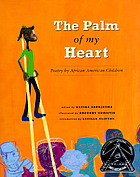
The Palm of my Heart edited by Davida Adedjouma

Adedjouma, Davida. 1996. The palm of my heart: poetry by African American children. Ill. by R. Gregory Christie. New York: Lee & Low Books. ISBN 9781880000410

This collection of poems, a Coretta Scott King Award winner, contains poetry written by African American children as a part of an enrichment program taught by editor Adedjouma.  Each poem begins with the words "Black is . . ." and expresses the young poets' thoughts or experiences concerning race and skin color and identity.  Although each poem begins with the same words, the variety of ideas, themes, and nuances are varied and insightful.  Imagery and word choice are used to convey strong emotions.

While this collection would be inspiring for any young poets, it is a powerful resource for African American students who too often do not hear from writers who look like them or share their experiences.  Not only are the poets published in this volume African American, they are all young people ranging from eight to fourteen years old at the time of publication.To read and experience poetry from children their own age is a valuable experience for young readers and writers.  The illustrations have an appealing style and again feature African American faces that complement the poems.  Each young poet is described in a brief biography at the end of the book.

Featured poem:

Black is dark,
dark is lovely,
lovely is the palm of my heart
and my heartbeats are filled with joy.

by Felicia Renee Brazil

As a way of introducing the poem, I would probably share with students some background about the poetry collection--that the poems were written by students near their own age and that each poet began with the same two words but created a variety of moods, thoughts, and expressions from those two words.  After reading this poem, I would ask the students to discuss the emotions that the poet associates with black and possibly compare it to another poem from the collection.

I would next ask the students to brainstorm to find one unifying characteristic that they all share that could serve as a opening line for a set of poems inspired by the concept of this book.

A Poke in the I selected by Paul B Janeczko

Janeczko, Paul B. 2001. A poke in the I. Ill. by Chris Raschka. Cambridge, MA: Candlewick Press. ISBN 9780763606619


Janeczko has selected thirty previously published concrete poems for this collection illustrated by Chris Raschka.  The variety and visual interest of these poems set this volume apart.  The artwork complements and adds interest and meaning to the unique shapes and forms of the poems.  Rather than relying on the imagery of the words alone, the poems represent and depict movement, shape, and meaning in many ways.  Most of the poems are very brief in word count, but rely heavily on sight and sound to convey meaning and engage interest.

The volume features a variety of poets (including one previously unpublished poem by the illustrator Raschka) with multiple poems by Robert Froman, Douglas Florian, and John Hollander.  While the poems vary greatly in length, complexity, and tone, they are connected by the interactive nature of the visual representations.  The poems and illustrations form one cohesive unit that will appeal to a broad range of abilities, interest levels, and moods of children. Janeczko provides an editor's note to help introduce and explain the idea of concrete poetry.  Several of the poems are grouped on a spread with poems of similar theme or meaning which adds continuity to the collection as a whole, and a table of contents provides access points to the various poems.

Featured poem:

"Popsicle" by Joan Bransfield Graham

Popsicle
Popsicle
tickle
tongue fun
licksicle
sticksicle
please
don't run
dripsicle
slipsicle
melt, melt
tricky
stopsicle
plopsicle
hand all
s
t
i
c
k
y

As it is printed in the book, the poem takes on the shape of a popsicle with all lines except the last word forming a rectangle of text and "sticky" written downward on the page to form the stick of the popsicle.

This poem is a great introduction to concrete poems because it's a simple and obvious shape that corresponds directly to the subject of the poem.  The language, made-up words, rhythm, and rhyme also make it an entertaining choice.

I would share the poem directly from the book to expose students to the shape and illustration.  Further concrete examples could also be shared from the collection.  After reading "Popsicle" and engaging students in some discussion of how shape and placement of a poem can add meaning just as much as word choice, I would encourage students to experiment with shape, font, and illustration of their own poems.

Monday, April 22, 2013

You Read to Me, I'll Read to You by Mary Ann Hoberman

Hoberman, Mary Ann. 2004. You read to me, I'll read to you: very short fairy tales to read together (in which wolves are tamed, trolls are transformed, and peas are triumphant). Ill. by Michael Emberley.  New York: Little, Brown. ISBN 978-0316207447

Part of a series of books by Hoberman that feature poems written to be performed by two readers, this volume features poems based on familiar fairy tales.  Short lines, rhyme, and rhythm are an important to each poem.  The illustrations by Emberley add humor and support to the text.  

The volume contains a table of contents, with each poem titled with the name of the fairy tale.  An author's note discussing the purpose and origin of the concept provides guidance for the performance of the poetry.

Featured poem:

The Three Little Pigs

I'm Big Bad Wolf.
I'm Little Pig.
You're very small.
You're very big.
Bug now I've got you
In my pot.
The water's getting
Very hot.
I'll cook you up
And make a stew.
Why, that's an awful
Thing to do.
Now that's a silly
Thing to say.
You ate my brother
Yesterday.
Why, so I did!
I had forgot.
(This water's getting 
Really hot.)
And on the day before
It's you
Who ate my other
Brother, too.
Did I do that?
That wasn't nice.
(Could you put in 
A little ice?)
They built their houses
In the town.
You huffed and puffed
And blew them down.
Well, they were made
Of straw and sticks
While yours is made
Of good strong bricks.
First I built
My house of bricks,
And then I fooled you
With my tricks.
And now you've got me
In your pot.
This water's really
Really hot!
Say you're sorry
Loud and clear.
I'm sorry.  Let me
Out of here!
Louder!  Clearer!
Give a shout!
I'M SORRY, PIG!
NOW LET ME OUT!
Now do you promise
To be nice?
I promise Pig.
Then here's some ice.
Sit down and cool
Yourself a bit.
I'll read you something
While you sit.
What will you read?
A tale that's true.
A tale about
Both me and you.
Can I read, too?
If you know how.
Of course I do.
Then let's start now.
(Unison)
We'll read Three Little Pigs
Right through
You'll read to me.
I'll read to you.

Since the poem is meant to be performed by two people, I would enlist a second reader and rehearse the poem before presenting to students.  Because the animals are the speakers of the poem, I would use a pig and a wolf puppet to present the poem.

After modeling a performance of the style of poetry contained in the book, I would ask students to team up and present some of the  poems contained within.  Providing costumes, puppets, or props can allow students to create unique performance experiences.  

Button Up! by Alice Schertle

Schertle, Alice. 2009. Button up!: wrinkled rhymes. Ill. by Petra Mathers.  New York: Harcourt Children's Books/ Houghton Mifflin Harcourt. ISBN 9780152050504

Winner of the 2010 Lee Bennett Hopkins Poetry Award and multiple starred reviews from journals, Button Up! is a collection of poems told from the perspective of articles of clothing that are surprisingly articulate and witty.  The illustrations by Mathers depict animal characters as the clothing owners and add detail and humor to Schertle's verses.

All of the poems use rhyme and a strong rhythm that make the poems interesting to read aloud.  Repetition and refrain are also frequently employed in the collection.  The language is appealing, full of enthusiasm and humor.  Even when the articles of clothing take their jobs seriously, the whimsy involved in the concept, illustrations, and poetic language make these poems uniformly entertaining and engaging.

Each poem is titled with the owner's name and the article of clothing and is listed in a table of contents to provide access points into the text.  Each poem gets a two-page spread for poem text and illustrations.

Featured poem:

Joshua's Jammies

We are the jammies that Joshua wears,
not jammies for penguins,
not jammies for bears,
not jammies for tigers with knots in their tails,
not jammies for chickens,
not jammies for whales,
not jammies for elephants going upstairs,
we are the jammies that Joshua wears.
We don't fit iguanas,
we're not for the gnu,
we won't suit the llamas
(they never wear blue).
Hippopotamus can't get us over his head.
We're JOSHUA's jammies.  We're going to bed.

Although the illustrations add such an interesting element to the poem, I would share this poem without showing the illustration to the students.  After reading the poem several times and possibly provided a copy of the text, I would ask students to illustrate this poem.  After students have envisioned their own drawings for the poem, I will share Mather's pictures and compare them to the student's works.  We will discuss how the illustrations affect the meaning of the poem.

Sunday, April 21, 2013

This Is Just to Say by Joyce Sidman

Sidman, Joyce. 2007. This is just to say: poems of apology and forgiveness. Ill. by Pamela Zagarenski. Boston: Houghton Mifflin Co. ISBN 978-0-618-61680-0

"This Is Just to Say" by William Carlos Williams served as inspiration for Joyce Sidman as she worked with students on poetry writing.  When the class encouraged her to send the apology poem she had written to her mother, Sidman was again inspired--this time to write a collection of apology poems from the perspective of a class of sixth grade students.  In this fictional scenario, the students also deliver their apology poems to the intended recipients and ask for poems in response.  The apologies and responses are collected in this volume and illustrated in the fictional setting by one of the students and in reality by Pamela Zagarenski.

The variety of the poems is intriguing and entertaining especially since all the poems have the same intention or purposes--to present an apology or express regret for an action.  The events that inspired the apologies range from the trivial (rubbing a statue's nose for luck) to the more serious (giving in to peer pressure and breaking all the garage windows), and the resulting poems present an emotional range of regret, sorrow, and fear in addition to a few poems showing a lack of serious contrition.  Young readers will find something here with which to identify as the misdeeds are so universal.  In addition to a variety of themes, the types and forms of the poems are also varied including a haiku and a pantoum, although most are free verse.

Most of the poets seem to find freedom or closure from their confessions and apologies, and many of the responses reveal the truth that the offense or inciting incident meant more to the apologist than the one who was wronged.  Most of the offenses have long been forgiven.  A few of the poems written to objects or animals or a couple of parents unwilling to participate are answered by other classmates who offer understanding and absolution as beset they can.

Although rhyme is not used much in this collection, strong rhythms and repetitions or refrains are frequently employed, which makes the poems especially good for oral reading or recitation.  Two poems incorporate Spanish words or phrases, and several of the poems and poets reveal various cultural backgrounds that add an appeal to readers with similar backgrounds.  The illustrations are simple but powerful.  Zagarenski (or the fictional Bao Vang) incorporates dictionary pages into the illustrations in a collage style that highlights significant words or themes (apology, apologize,etc.).  The use of lined paper and graph paper in the illustrations as well as the simple drawings and doodles reinforce the fact that they are supposedly created by a student.

The book is divided into two sections:  apologies and responses and is introduced with an editor's note from one of the students.  A table of contents provides access points for the readers with titles and individual student poets listed.  On each page or spread, the poem's intended recipient is noted above the title.

Featured poem:

Since the poem's are really written in pairs, I would share both the apology and its response.

Fashion Sense (to Mrs. Munz)

I am so sorry for my rude words.

The classroom was so dead.
No one had anything more to say about Old Yeller,
and we were all crazy to get outside.
The silence seemed like a hundred crushing elephants.
So I raised my hand and made that comment
about your dress,
and everyone burst out laughing.

You smiled,
but your smile looked like a frozen pond.

People were high-fiving me on the way
down to lunch, but I felt like a traitor.
You know how the words slip out and you can't believe it?
And they echo in your head forever and ever?
All through lunch, and through recess,
all the next day, I wished I could take those words back.
I kept thinking of what you always say to us:
words can help or hurt, the choice is ours.
I want to rewind to that moment and say instead,
"Mrs. Merz, that dress makes you look like a princess."

You are really a queen not a princess.
Our queen.  Reina de la clase.
I hope you will overlook the transgressions
of your loyal but loud-mouthed subject
and forgive me.

(P.S. I notice you'tr not wearing that dress so much anymore.
Green is not good on you anyway.  I like the new one,
with blue in it, which makes you look thinner.)

by Carmen

Haiku for Carmen

Just these few warm words,
and spring sunlight fills the room;
my dress turns to sky.

by Mrs. Ruth Merz

I think these two poems together demonstrate something important about expression and emotion.  Carmen's poem, one of the longest in the book, has both narrative elements, describing the series of events as well as her thoughts and emotions throughout the whole experience.  Although the poem is related to one specific incident, it shows us several things about Carmen.  She sets the scene in a way that seems to make excuses for why she was rude, but the contrition she describes also seems very sincere.  Her post script also seems to indicate that Carmen can be blunt with her opinion.  Mrs. Merz's poem, whose length is mandated by the haiku form that she chose, is the opposite of Carmen's.  It's brief and spare compared to all the words of the apology poem, but it also tells us quite a bit about Mrs. Merz, that she enjoys her students and basks in warm relationships with them, that she is forgiving, and that no matter how grown up she is, it's still nice to receive compliments.

After sharing the poems, I would engage the students in a discussion of the differences and similarities in the poem.  I would also highlight the line from Carmen's poem about the advice that Mrs. Munz has given, "words can help or hurt, the choice is ours" and ask the students if Carmen's poem demonstrates whether or not she has learned that lesson.

I would also want students to write their own apology poem for some transgression, a misdeed or an unkind word.  Students who want to share their poems would be encouraged to do so.

Monday, April 8, 2013

Black Jack by Charles R. Smith Jr.


Smith, Charles R. 2010. Black Jack: the ballad of Jack Johnson. Ill. by Shane W. Evans.  New York: Roaring Brook Press. ISBN 9781596434738

This ballad depicts the life of heavyweight boxer Jack Johnson who became the first black heavyweight champion in 1910.  In addition to his boxing success, the poem paints a portrait of a proud man, the son of former slaves, who would not accept the racial discrimination that defined the era in which he lived.

The poet uses rhyme and rhythm to create the narrative poem, sometimes incorporating quotes or slang of the time period to lend a more realistic feel to the story.  In addition to relaying the events of Jack's life in poetic form, the ballad also evokes emotion through descriptions of Jack's family and upbringing, the hardships and discrimination that he faced, and the triumphs that he experienced as a boxer.

Featured poem:
an excerpt of the description of his childhood

But it was words from his mother,
whom Jack loved so dear,
that Jack took to heart
when they entered his ear:

"Jack, you are the BEST boy
in the world.  You can do
ANYTHING you want if
you want it badly enough."

Since the entire book is brief, I would be more inclined to share the entire ballad and show off the bold illustrations by Evans, but this poem would also work well on its own to demonstrate how Johnson developed the strong character necessary to cross the color line in boxing and demand equal treatment.

I would share Black Jack as a part of Black History Month in February and ask the students to use the ballad form demonstrated in the poem to write about another figure from history that we studied.