Tuesday, June 25, 2013

Where Things Come Back by John Corey Whaley

Whaley, J. C. (2011). Where things come back. New York: Atheneum Books for Young Readers.

The small town of Lily, Arkansas is situated halfway between Little Rock and Memphis and is the sort of place that people dream of leaving.  The summer before his senior year of high-school, Cullen Witter witnesses people coming to Lily instead of leaving.  An alleged sighting of the Lazarus woodpecker thought to be extinct for seventy years brings notoriety to Cullen’s hometown.  The woodpecker becomes a symbol for second chances to the people of Lily and the bird enthusiasts who flock there, but when Cullen’s younger brother Gabriel disappears without a trace one night, his family and friends are left hopeless, desperately in need of a second chance. 

Whaley’s novel is rooted in a real place and time.  The ivory-billed woodpecker, long thought to be extinct, was spotted in the Big Woods region of Arkansas in 2004, and its existence  has been the subject of debate among ornithologists for the past several years.  Teens in Arkansas, especially in the central and delta areas surrounding the Big Woods will be old enough to remember the extensive news coverage surrounding the bird as well as the locally-published children’s books such as Big Woods Bird (Luneau & Bennett, 2005) that were distributed in classrooms across the state.  While the story of Gabriel’s disappearance and the Witter family’s struggle to deal with the loss is the true focal point of the novel, the woodpecker subplot is woven throughout and comes to have great significance in Cullen’s recollections of that summer.  Readers familiar with Arkansas may also appreciate the many geographic names from around the state that are used as character names throughout the novel. 

Interspersed with the chapters narrated by Cullen, are sections told from a third-person point of view that introduce the character Benton Sage, a young missionary in Ethiopia and later a college student in Georgia.  His experiences and relationship with his roommate Cabot Searcy at first appear to be completely unrelated to the events unfolding in Lily, but the author eventually weaves these two story lines together through some surprising twists and turns.  Benton and Cabot both demonstrate the same single-minded passion and pursuit of goals that characterizes the zealous woodpecker-seekers in Arkansas, and their particular interest in biblical texts and apocrypha connects to the other storyline through the name of the woodpecker.  Of course, there is no Lazarus woodpecker, the name is an allusion to the biblical story of one who returns from the dead, underlining the hope and belief in second chances that the bird represents to the town. 

Although the novel is has a realistic setting and plot, Cullen’s narration often turns fanciful with extended descriptions of his zombie-filled daydreams and nightmares as well as his notations of amusing book title ideas he records in his journal.  Although these elements provide some humor, it can sometimes be a little tricky for the reader to determine where reality ends and fantasy begins.

Small town life is authentically portrayed as are the teen characters of Cullen, his best friend Lucas, and the various friends, enemies, and love interests Cullen describes.  The descriptions of how each family member and close friend deals with Gabriel’s disappearance as well as Cullen’s perception of how the town bears with them through the loss are vivid and realistic.  Readers who have experienced tragedy or loss will appreciate how the narrative demonstrates the duality of time marching onward and standing still.  Although the subject matter is serious and the emotional descriptions haunting, Whaley provides moments of humor and levity that seem to mimic the ups and downs of real life.

References
Luneau, T. R., & Bennett, T. (2005). Big Woods bird: An ivory-bill story. Little Rock, AR: Kury Lane Inc.


Tuesday, June 18, 2013

Speak by Laurie Halse Anderson

Anderson, L. H. (1999). Speak. New York: Farrar Straus Giroux.


Melinda Sordino enters the ninth grade “clanless,” without a group of friends to define her identity.  Her former friends shun her, and when she does draw the notice of teachers or other students, it’s the wrong kind of attention.  She withdraws into her own haunting thoughts, burying her pain in long silences and a year-long art assignment that will push her to deal with the tumultuous memories that plague her.

Despite the fact that it was written over a decade ago, the subject matter of Speak could have been inspired by much more recent headlines:  a teenage girl, drunk at a party, a victim of sexual assault at the hands of a popular athlete.  The only difference in Melinda’s story and the real-life tragedies that have made news in the past few years is that there’s no social media to testify to what happens to her.  Her rape is a closely guarded secret—one that she manages to compartmentalize and keep even from herself much of the time, yet she is still criminalized by peers who don’t know the whole story.  Melinda is left to deal with the emotional fallout of her ordeal on her own.          

Although Melinda stops communicating with her parents, teachers, and classmates, her first person narration of the story is highly descriptive, full of evocative imagery and perceptive observation of the people and events around her.  Her thoughts and judgments of others are sometimes biting in their sarcasm, but this trait lends an authentic teenage voice to the narration.  The realism, raw emotion, and feelings of powerlessness that Melinda expresses will likely find a ready audience with teenagers who can often feel marginalized and silenced due to parents, teachers, and peers who do not understand or provide support to their inner struggles.

Throughout the novel, Melinda must endure encounters with her attacker who goes to her school, and while he seems to taunt her through these interactions, it’s somewhat unclear whether this is Melinda’s perception or what’s actually happening between them.  A final confrontation near the end of the book brings them face to face once again and seems to reveal her adversary as a person who displays every confidence that he will continue to get away with his abusive treatment of girls.  While it is easy to sympathize and relate to Melinda, even for people who have not experienced a similar trauma, the antagonist and his actions seem almost too horrible to be believed.  Perhaps his character is just as realistic as the others in the story, but the way he maneuvers himself into his final scene with Melinda seems just a little far-fetched.

The difficult subject matter have made this novel the target of challenges and attempted censorship, but the realistic portrayal of the cruelties of high school and adolescence along with the ultimately hopeful message provide ample cause to keep this book on library shelves and easily accessible to teen readers.           

Tuesday, June 11, 2013

I Am the Cheese by Robert Cormier

Cormier, R. (1977). I am the cheese. New York: Knopf.

The story of Adam Farmer begins when he sets out on a bicycle trip from Monument, Massachusetts, to Rutterburg, Vermont to see his father.  Along the way, he encounters dangers of the road, some of his worst fears, and a few helping hands.  Interspersed with Adam’s first person account of his journey and his recollections of happier times are transcripts of interviews between Adam and Brint, a doctor who is trying to help Adam regain his memories.  Through their conversations and Adam’s trip narrative, the clues about Adam’s family and past unravel. 
            The multiple points of view to which the reader has access through Adam’s travel narrative, the interview transcripts, and the third person descriptions of some of Adam’s memories that are recalled during the interview sessions highlight the unreliability of Adam as a narrator while leaving clues and foreshadowing for the reader to solve the mystery of the Farmer family.  Multiple viewpoints or shifts in narration from first to third person may be more common in contemporary young adult literature, but for its time, this was a likely an innovative literary device.  The  events of the story also cast doubts upon certain aspects of the government in a move that mimics the trends in adult literature of the same time and is a precursor to conspiracy theories and exposés that abound in popular fiction (and nonfiction) today.
            Like so many other young adult novels that have remained perennial favorites among both teens and the teachers and librarians who recommend and advocate for them, I Am the Cheese is a story of seeking out identity.  In Adam’s case, this may be a more literal quest than other works, but the story is told in such a way that even if teens cannot relate to the specific circumstances of Adam’s life, they will connect to his exploration of memories as he tries to piece together and explain his life.  The mystery and adventure of his bike trip will also likely resonate with readers who are eager to gain independence from home and family while the treatment of Adam’s many fears along the way can be viewed as reassuring or affirming to readers who may be dealing with their own fears and insecurities about growing up, changing relationships, and identity.  I believe that the accessibility of the teen characters of Adam and Amy in the book and these themes of identity, insecurity, and independence are the greatest strengths of the novel.  As someone who reads a great deal of young adult literature, I can see the influence of Cormier’s writing and characters in the writing of more contemporary realistic fiction.  As I read, I noticed several instances or descriptions that will make this novel seem dated to today’s young readers.  Adam has to use pay phones in his attempts to contact his friend Amy along his journey, and during one of the calls, the operator cuts in to speak to him.  Although I can recall a time before cell phones when pay phones were a necessary part of life, but today’s teens will have little or no reference for this plot point.  Some of the literary and musical references will be similarly outside the experience of current readers.  This could be perceived as a drawback to some teens who aren’t interested in outdated references in books or movies, but the overall strength of the characters, plot, and theme of the story ultimately outweigh this drawback. 


Monday, May 6, 2013

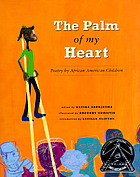
The Palm of my Heart edited by Davida Adedjouma

Adedjouma, Davida. 1996. The palm of my heart: poetry by African American children. Ill. by R. Gregory Christie. New York: Lee & Low Books. ISBN 9781880000410

This collection of poems, a Coretta Scott King Award winner, contains poetry written by African American children as a part of an enrichment program taught by editor Adedjouma.  Each poem begins with the words "Black is . . ." and expresses the young poets' thoughts or experiences concerning race and skin color and identity.  Although each poem begins with the same words, the variety of ideas, themes, and nuances are varied and insightful.  Imagery and word choice are used to convey strong emotions.

While this collection would be inspiring for any young poets, it is a powerful resource for African American students who too often do not hear from writers who look like them or share their experiences.  Not only are the poets published in this volume African American, they are all young people ranging from eight to fourteen years old at the time of publication.To read and experience poetry from children their own age is a valuable experience for young readers and writers.  The illustrations have an appealing style and again feature African American faces that complement the poems.  Each young poet is described in a brief biography at the end of the book.

Featured poem:

Black is dark,
dark is lovely,
lovely is the palm of my heart
and my heartbeats are filled with joy.

by Felicia Renee Brazil

As a way of introducing the poem, I would probably share with students some background about the poetry collection--that the poems were written by students near their own age and that each poet began with the same two words but created a variety of moods, thoughts, and expressions from those two words.  After reading this poem, I would ask the students to discuss the emotions that the poet associates with black and possibly compare it to another poem from the collection.

I would next ask the students to brainstorm to find one unifying characteristic that they all share that could serve as a opening line for a set of poems inspired by the concept of this book.

A Poke in the I selected by Paul B Janeczko

Janeczko, Paul B. 2001. A poke in the I. Ill. by Chris Raschka. Cambridge, MA: Candlewick Press. ISBN 9780763606619


Janeczko has selected thirty previously published concrete poems for this collection illustrated by Chris Raschka.  The variety and visual interest of these poems set this volume apart.  The artwork complements and adds interest and meaning to the unique shapes and forms of the poems.  Rather than relying on the imagery of the words alone, the poems represent and depict movement, shape, and meaning in many ways.  Most of the poems are very brief in word count, but rely heavily on sight and sound to convey meaning and engage interest.

The volume features a variety of poets (including one previously unpublished poem by the illustrator Raschka) with multiple poems by Robert Froman, Douglas Florian, and John Hollander.  While the poems vary greatly in length, complexity, and tone, they are connected by the interactive nature of the visual representations.  The poems and illustrations form one cohesive unit that will appeal to a broad range of abilities, interest levels, and moods of children. Janeczko provides an editor's note to help introduce and explain the idea of concrete poetry.  Several of the poems are grouped on a spread with poems of similar theme or meaning which adds continuity to the collection as a whole, and a table of contents provides access points to the various poems.

Featured poem:

"Popsicle" by Joan Bransfield Graham

Popsicle
Popsicle
tickle
tongue fun
licksicle
sticksicle
please
don't run
dripsicle
slipsicle
melt, melt
tricky
stopsicle
plopsicle
hand all
s
t
i
c
k
y

As it is printed in the book, the poem takes on the shape of a popsicle with all lines except the last word forming a rectangle of text and "sticky" written downward on the page to form the stick of the popsicle.

This poem is a great introduction to concrete poems because it's a simple and obvious shape that corresponds directly to the subject of the poem.  The language, made-up words, rhythm, and rhyme also make it an entertaining choice.

I would share the poem directly from the book to expose students to the shape and illustration.  Further concrete examples could also be shared from the collection.  After reading "Popsicle" and engaging students in some discussion of how shape and placement of a poem can add meaning just as much as word choice, I would encourage students to experiment with shape, font, and illustration of their own poems.

Monday, April 22, 2013

You Read to Me, I'll Read to You by Mary Ann Hoberman

Hoberman, Mary Ann. 2004. You read to me, I'll read to you: very short fairy tales to read together (in which wolves are tamed, trolls are transformed, and peas are triumphant). Ill. by Michael Emberley.  New York: Little, Brown. ISBN 978-0316207447

Part of a series of books by Hoberman that feature poems written to be performed by two readers, this volume features poems based on familiar fairy tales.  Short lines, rhyme, and rhythm are an important to each poem.  The illustrations by Emberley add humor and support to the text.  

The volume contains a table of contents, with each poem titled with the name of the fairy tale.  An author's note discussing the purpose and origin of the concept provides guidance for the performance of the poetry.

Featured poem:

The Three Little Pigs

I'm Big Bad Wolf.
I'm Little Pig.
You're very small.
You're very big.
Bug now I've got you
In my pot.
The water's getting
Very hot.
I'll cook you up
And make a stew.
Why, that's an awful
Thing to do.
Now that's a silly
Thing to say.
You ate my brother
Yesterday.
Why, so I did!
I had forgot.
(This water's getting 
Really hot.)
And on the day before
It's you
Who ate my other
Brother, too.
Did I do that?
That wasn't nice.
(Could you put in 
A little ice?)
They built their houses
In the town.
You huffed and puffed
And blew them down.
Well, they were made
Of straw and sticks
While yours is made
Of good strong bricks.
First I built
My house of bricks,
And then I fooled you
With my tricks.
And now you've got me
In your pot.
This water's really
Really hot!
Say you're sorry
Loud and clear.
I'm sorry.  Let me
Out of here!
Louder!  Clearer!
Give a shout!
I'M SORRY, PIG!
NOW LET ME OUT!
Now do you promise
To be nice?
I promise Pig.
Then here's some ice.
Sit down and cool
Yourself a bit.
I'll read you something
While you sit.
What will you read?
A tale that's true.
A tale about
Both me and you.
Can I read, too?
If you know how.
Of course I do.
Then let's start now.
(Unison)
We'll read Three Little Pigs
Right through
You'll read to me.
I'll read to you.

Since the poem is meant to be performed by two people, I would enlist a second reader and rehearse the poem before presenting to students.  Because the animals are the speakers of the poem, I would use a pig and a wolf puppet to present the poem.

After modeling a performance of the style of poetry contained in the book, I would ask students to team up and present some of the  poems contained within.  Providing costumes, puppets, or props can allow students to create unique performance experiences.  

Button Up! by Alice Schertle

Schertle, Alice. 2009. Button up!: wrinkled rhymes. Ill. by Petra Mathers.  New York: Harcourt Children's Books/ Houghton Mifflin Harcourt. ISBN 9780152050504

Winner of the 2010 Lee Bennett Hopkins Poetry Award and multiple starred reviews from journals, Button Up! is a collection of poems told from the perspective of articles of clothing that are surprisingly articulate and witty.  The illustrations by Mathers depict animal characters as the clothing owners and add detail and humor to Schertle's verses.

All of the poems use rhyme and a strong rhythm that make the poems interesting to read aloud.  Repetition and refrain are also frequently employed in the collection.  The language is appealing, full of enthusiasm and humor.  Even when the articles of clothing take their jobs seriously, the whimsy involved in the concept, illustrations, and poetic language make these poems uniformly entertaining and engaging.

Each poem is titled with the owner's name and the article of clothing and is listed in a table of contents to provide access points into the text.  Each poem gets a two-page spread for poem text and illustrations.

Featured poem:

Joshua's Jammies

We are the jammies that Joshua wears,
not jammies for penguins,
not jammies for bears,
not jammies for tigers with knots in their tails,
not jammies for chickens,
not jammies for whales,
not jammies for elephants going upstairs,
we are the jammies that Joshua wears.
We don't fit iguanas,
we're not for the gnu,
we won't suit the llamas
(they never wear blue).
Hippopotamus can't get us over his head.
We're JOSHUA's jammies.  We're going to bed.

Although the illustrations add such an interesting element to the poem, I would share this poem without showing the illustration to the students.  After reading the poem several times and possibly provided a copy of the text, I would ask students to illustrate this poem.  After students have envisioned their own drawings for the poem, I will share Mather's pictures and compare them to the student's works.  We will discuss how the illustrations affect the meaning of the poem.