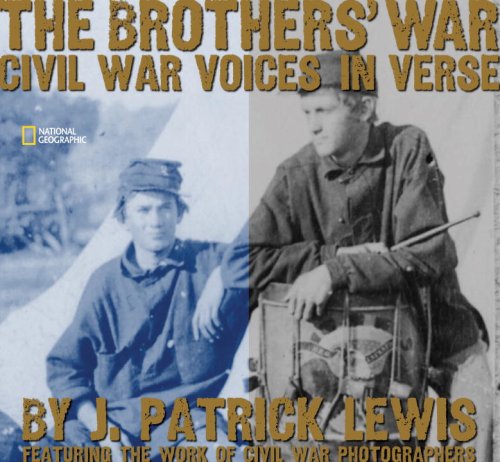
In this collection, J. Patrick Lewis gives a voice to slaves, soldiers, generals, and citizens who were a part of the Civil War. Each poem is accompanied by photographs from that era as well as a note about the context, person, or situation that is depicted by the poem. The end of the book features a map, timeline, bibliography for further reading, a note about the photography and Lewis's further notes and explanations of each of the poems. The table of contents provides access points to the eleven poems.
Each poem is told from a distinct perspective, the speaker a real person or a realistic representative of the time period. Some are well-known such as abolitionist John Brown or former slave Frederick Douglass or Union General William Sherman, and others are merely the anonymous voices of soldiers and slaves. Each poem is distinct in perspective and tone, but each also flows together to present a view of the war and time period as a whole.
Most of the poems use rhyme, and many have a strong rhythm. Word choice and dialect are important to conveying the difference in the speakers of the poem. The imagery used in the poems is enhanced by the photographs which put faces onto nameless soldiers or depict some of the more gruesome aspects of war.
Featured poem:
Blood of Our Fathers, Blood of Our Sons
The First Battle of Bull Run July 21, 1861
Five thousand fell that day by Sudley Road,
Five thousand left their mothers in despair.
a world gone red--the Bull Run overflowed
With blood, raining in the violent air.
On Widow Henry's fallow fields, I saw
A boy about my age fall where he stood,
Face down, writing, clutching at mud and straw,
As if God's earth could do him any good.
By what outrageous powers of circumstance
Do men take arms against their very own?
The Yankee sergeant's bullet snapped the bone.
Roy Pugh, his Rebel son, had little chance.
Distraught, the sergeant rolled him on his side.
Roy whispered, "Father . . . Why?" before he died.
Although this poem is a depiction of a specific battle, the impact of it truly comes in its depiction of father and son forced into battle against each other by the opposing viewpoints that defined the war. The poet's note at the end of the book directs readers to a firsthand narrative of a similar event at http://www.eyewitnesstohistory.com/malvern.htm.
I would share first the poem and then the website account with students when discussing the ideological divisions that affected so many families. Students will write two poems depicting a battle or the overall war from two opposing viewpoints, North and South, slave and slave-owner, etc.
Each poem is told from a distinct perspective, the speaker a real person or a realistic representative of the time period. Some are well-known such as abolitionist John Brown or former slave Frederick Douglass or Union General William Sherman, and others are merely the anonymous voices of soldiers and slaves. Each poem is distinct in perspective and tone, but each also flows together to present a view of the war and time period as a whole.
Most of the poems use rhyme, and many have a strong rhythm. Word choice and dialect are important to conveying the difference in the speakers of the poem. The imagery used in the poems is enhanced by the photographs which put faces onto nameless soldiers or depict some of the more gruesome aspects of war.
Featured poem:
Blood of Our Fathers, Blood of Our Sons
The First Battle of Bull Run July 21, 1861
Five thousand fell that day by Sudley Road,
Five thousand left their mothers in despair.
a world gone red--the Bull Run overflowed
With blood, raining in the violent air.
On Widow Henry's fallow fields, I saw
A boy about my age fall where he stood,
Face down, writing, clutching at mud and straw,
As if God's earth could do him any good.
By what outrageous powers of circumstance
Do men take arms against their very own?
The Yankee sergeant's bullet snapped the bone.
Roy Pugh, his Rebel son, had little chance.
Distraught, the sergeant rolled him on his side.
Roy whispered, "Father . . . Why?" before he died.
Although this poem is a depiction of a specific battle, the impact of it truly comes in its depiction of father and son forced into battle against each other by the opposing viewpoints that defined the war. The poet's note at the end of the book directs readers to a firsthand narrative of a similar event at http://www.eyewitnesstohistory.com/malvern.htm.
I would share first the poem and then the website account with students when discussing the ideological divisions that affected so many families. Students will write two poems depicting a battle or the overall war from two opposing viewpoints, North and South, slave and slave-owner, etc.

No comments:
Post a Comment