Monday, April 8, 2013

The Brothers' War by J. Patrick Lewis

Lewis, J. Patrick. 2007. The brothers' war: Civil War voices in verse. Washington, D.C.: National Geographic. ISBN 9781426300363

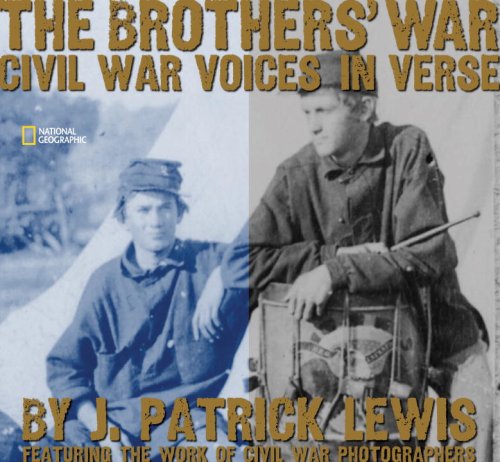
In this collection, J. Patrick Lewis gives a voice to slaves, soldiers, generals, and citizens who were a part of the Civil War.  Each poem is accompanied by photographs from that era as well as a note about the context, person, or situation that is depicted by the poem.  The end of the book features a map, timeline, bibliography for further reading, a note about the photography and Lewis's further notes and explanations of each of the poems.  The table of contents provides access points to the eleven poems.

Each poem is told from a distinct perspective, the speaker a real person or a realistic representative of the time period.  Some are well-known such as abolitionist John Brown or former slave Frederick Douglass or Union General William Sherman, and others are merely the anonymous voices of soldiers and slaves.  Each poem is distinct in perspective and tone, but each also flows together to present a view of the war and time period as a whole.

Most of the poems use rhyme, and many have a strong rhythm.  Word choice and dialect are important to conveying the difference in the speakers of the poem.  The imagery used in the poems is enhanced by the photographs which put faces onto nameless soldiers or depict some of the more gruesome aspects of war.

Featured poem:

Blood of Our Fathers, Blood of Our Sons
The First Battle of Bull Run July 21, 1861

Five thousand fell that day by Sudley Road,
Five thousand left their mothers in despair.
a world gone red--the Bull Run overflowed
With blood, raining in the violent air.
On Widow Henry's fallow fields, I saw
A boy about my age fall where he stood,
Face down, writing, clutching at mud and straw,
As if God's earth could do him any good.
By what outrageous powers of circumstance
Do men take arms against their very own?
The Yankee sergeant's bullet snapped the bone.
Roy Pugh, his Rebel son, had little chance.
Distraught, the sergeant rolled him on his side.
Roy whispered, "Father . . . Why?" before he died.

Although this poem is a depiction of a specific battle, the impact of it truly comes in its depiction of father and son forced into battle against each other by the opposing viewpoints that defined the war.  The poet's note at the end of the book directs readers to a firsthand narrative of a similar event at http://www.eyewitnesstohistory.com/malvern.htm.

I would share first the poem and then the website account with students when discussing the ideological divisions that affected so many families.   Students will write two poems depicting a battle or the overall war from two opposing viewpoints, North and South, slave and slave-owner, etc.

Sunday, April 7, 2013

The Tree that Time Built selected by Mary Ann Hoberman and Linda Winston

Hoberman, Mary Ann, Linda Winston, and Barbara Fortin. 2009. The tree that time built: a celebration of nature, science, and imagination. Napperville, IL: Sourcebooks Jabberwocky. ISBN 9781402225178

Mary Ann Hoberman, the U.S. Children's Poet Laureate from 2008-2010, and Linda Winston, an anthropologist and teacher have selected quite a collection of science and nature poems in this anthology from a wide variety classic and contemporary poets. The volume is divided in nine loosely themed sections and includes section introductions, footnotes, notes on the poets, an index, and a glossary to help guide readers.  The book is accompanied by a cd containing recordings of forty-four of the poems, many read by the poets themselves.  References to track numbers on the cd are included in the table of contents as well as on the pages containing the recorded poems.

With so many poems, there is naturally a wide range of styles, forms, and tones to the poems in this collection.  From brief but richly constructed haiku to fanciful, lighthearted treatments of animals and plants to solemn and sparse depictions of the world, there is sure to be a poem to appeal to all types of readers.  The rhythm, sound, and word choice used in the poems are especially easy to note when listening to the accompanying cd as are the various emotions evoked by the poems.

One of the most appealing aspects of the volume is the inclusion of centuries-old poems alongside poems by the poets of today.  As the anthology's selectors make connections and reference to Darwin's work in evolution, the poems themselves represent an evolution of poetic expression over time.  Simple, playful poems appear alongside more intricate, though-provoking ones, and the whole, while perhaps too extensive to be consumed in a single sitting, provides a variety of avenues to explore and discover making scientists out of poets and poets out of scientists.

Featured poem:

Procyonidae by Mary Ann Hoberman

If you give a little whistle,
You might meet a cacomistle,
A coati or olingo
Or a raccoon with a ring-o;
I can name them by the dozens
And all of them are cousins
                       And they're all related to the giant panda!

The kinkajou's another
That is practically a brother
To coatis and olingos
And to raccoons with their ring-os;
And every single one of them
Is different, that's the fun of them
                       Yet every one's related to the panda!

Now they all have different faces
And they live in different places
And they all have different sizes,
Different noses, different eyeses;
But the family name for all of them
Is just the same for all of them
                       And each one is related to the panda!

The note accompanying this poem explains that when it was written, the panda was classified in the same animal family (Procyonidae) as the raccoon, and the poem connects the panda to its relatives in that family.  In the 1980s, the panda was reclassified based on DNA study into the bear (Ursidae) family.  So although the poem is no longer accurate, it represents how what we know and understand about our world can change as science allows us to discover more and more.

Sharing this poem and the story behind its inclusion in the book would be a wonderful introduction to the scientific method, reminding students that our hypotheses and theories about how or why something is the way it is must stand up to evidence.

Another idea would be to share the recording of the poem (and Hoberman's insight into its background) when studying animal families.  Ask the students to identify traits or aspects of the giant panda that connect it to the raccoon or bear families.  Then ask the students to write an updated version of the poem called Ursidae that connects the giant panda to various relatives in the bear family.  Keeping the same rhythm or rhyme scheme as Hoberman uses in the original poem would be a fun idea to help the poems match each other.

Friday, April 5, 2013

"Restless" by Joyce Sidman

Our midterm project was to create a "poem movie."  Here's my movie for "Restless" by Joyce Sidman, published in The Poetry Friday Anthology for Middle School edited by Sylvia Vardell and Janet Wong.

Monday, March 4, 2013

Things Left Unsaid by Stephanie Hemphill


Hemphill, Stephanie. 2005. Things left unsaid : a novel in poems. New York: Hyperion. ISBN 9780786818501

In her debut novel, Hemphill tells the story of high-school junior Sarah, a model student and daughter, who begins to question her life and decisions.  When she is befriended by Robin, a rebellious classmate, Sarah is drawn to the danger and dark glamour of a new life so unlike her old one.  In the end, Robin's self-destructive lifestyle helps Sarah to realize the danger of blindly following, and she must begin to find her own identity.

The novel is told entirely in titled, free verse poems.  Many can stand alone with interest and meaning outside the context of the novel.  Sarah, as the speaker of all the poems, is honest and vulnerable in depicting her confusion and questioning of life.  The poems contain some narrative elements and dialogue, but many are simply descriptive of Sarah's actions and reactions to the events going on around her.  The language is vivid and descriptive, and the poems convey a strong rhythm.

Teens, especially girls, will be drawn to the clear writing and events and emotions depicted in the novel.  The characters are realistic and representative of several teenage archetypes.  The themes of identity, peer pressure, and friendship are especially relevant to teen audiences.  Hemphill does not shy away from sensitive topics, addressing eating disorders, suicide, alcoholism, and abusive parents with honesty and understanding.

This book was awarded the 2006 Myra Cohn Livingston Award for Excellence in Poetry by the Children's Literature Council of Southern California.

Feature poem:

Under This Skin

I itch,
not pathologically,
but like I'll feel great relief
if I untie my wool scarf

and let my neck bathe
in sunlight.
I'm ready to take
something off

shed the heavy layers.

In the novel, this poem describes Sarah coming out of a time of worry and depression after the attempted suicide of her friend.  She is coming to terms with her own sense of self and getting ready to start living her life on her own terms.  It is a pivotal point in the plot where readers see Sarah start to take control of her life.

With or without the context of the novel, this poems is evocative of throwing off old ways or feelings that weigh down or hold back.  The imagery lends itself to self-expression and new freedom.  This poem would be an excellent introduction to getting students to engage in personal or creative writing such as poetry.  Every year my library holds a teen poetry performance competition, and we try to share poems with them that will inspire them to find or write poems that express their emotions and that also inspire them to speak, read, or recite.  This would be an excellent poem to use an example or inspiration for that purpose.


Blue Lipstick: Concrete Poems by John Grandits

Grandits, John. 2007. Blue lipstick: concrete poems. New York: Clarion Books. ISBN 9780618568604

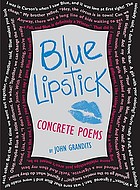
Concrete poems use the shape of the words and lines to convey meaning.  In Blue Lipstick, John Grandits revisits the characters from his earlier book Technically It's Not My Fault as well as the concrete poetry style to tell the story of fifteen-year-old Jessie.  The title poem on the book's cover introduces us to the cast of characters:  Jessie, her parents, her little brother Robert, and best friend Lisa.  We also get a glimpse into Jessie's personality as a girl who likes to be different and take risks.  These relationships and traits are further explored in the rest of the poems in the volume.  

Many of the meanings or themes are enhanced by the forms of the poems themselves, and the visual impact of the poems are as striking as the honest portrayal of teenage life.  Jessie, as the speaker of all the poems, is articulate and creative using figurative language and strong images to convey a wide range of emotions.

The wide range of topics with varying levels of seriousness and angst depict a realistic and relatable portrait of a teenage girl who is by turns angst-ridden, insecure, and insightful.  In her quest to be an individual, Jessie reveals that she is just like everyone else.  Teen readers, especially girls, will relate to the emotions and situations in the poems, and adult readers will also find themselves drawn to the collection.

The poems can mostly stand alone but are enhanced by the unified collection which is arranged in a rough chronology with some poems making references back to previous ones.  The relationships between Jessie and her parents and brother can especially be seen to develop across several poems.  The volume is book-ended by two versions of a poem called "The Wall" that describes the people who are on Jessie's side versus those who are on the opposing side of the wall.  The second version of this poem acknowledges that some people, once considered enemies, have come to Jessie's side of the wall.  

In this collection, Grandits uses his design background to give the poems shape and additional meaning.  The book received a starred review from School Library Journal as well a appearing on SLJ's Best Books of the Year list.  It is an ALA Notable Book and an ALA Quick Pick for Young Adults.  It won a Lee Bennett Hopkins Poetry Honor Award.

Featured poem: 
(The poem is written on black lines surrounding blocks of color in the manner of the art described in the painting.  There are no line breaks in the poem because of its design.)

Mondrian

Dad and I went to the Art Institute.
There was a show of work by Mondrian, and the guy totally rocks!
He did these paintings with just boxes and lines,
and he only used black and yellow and blue and red. 
I mean, he didn't mix his colors at all.
It was so simple and so elegant. 
I said, "I wish I could do that when I grow up--
make ultra-cool radical art."
Dad said, "It's not easy 
to be creative." 
And I thought to myself, "You wouldn't believe how creative
I have to be just to get through the day."
He said, "It's tough being an artist.
You've got to struggle for years.
People often misunderstand your work.
You've got to be thick-skinned because critics can be cruel.
You don't have any money.  And in many ways,
you're really alone."
And I said,
"It sounds like high school."

This poem would be a fun introduction into the art of Piet Mondrian.  After sharing the poem, students could explore his work through the Museum of Modern Art website (http://www.moma.org/collection/artist.php?artist_id=4057).  In an art class, students could also be encouraged to create their own paintings or art pieces showing the influence of Cubism.

Aside from the art connection, the comparison of an artist's life to that of a high school student could lead to a discussion of other occupations or life situations that might also correlate to aspects of teenage life.

The President's Stuck in the Bathtub: Poems about the Presidents by Susan Katz

Katz, Susan. 2012. The president's stuck in the bathtub: poems about the presidents. Ill. by Robert Neubecker. Boston: Clarion Books. ISBN 9780547182216

In forty-three poems, each President of the United States is acknowledged and celebrated for some distinct aspect of his life or presidency.  Although Grover Cleveland is counted as two Presidents because of his nonconsecutive term, he only gets one poem here.  Katz focuses on the more whimsical and lighthearted stories and characteristics of the nation's leaders and provides a few sentences accompanying each poem that give more information on the poem's topic.  The simple cartoonish illustrations by Neubecker add to the humor and playfulness of the poems.

Nearly all of the poems contain some sort of rhyme and occasional approximate rhyme.  Unusual word choices and figurative language also add to the impact of the poems.  One poem particularly that describes Warren G. Harding's alliterative oratory employs impressive alliteration very effectively.  Lincoln's poem, about his trademark stovepipe hat, is a concrete poem with the text set in the shape of the hat.

Many of the poems are narratives describing a particular event.  As this style of poetry has been found to be popular with students, this feature will make the overall book more appealing to young readers.  The variety of topics from Presidential nicknames, pets, and physical oddities to the more noteworthy achievements grants readers a glimpse into the lives of men who have played a fascinating part in American history.  The poems are informative in presenting an overall picture of the lives of the Presidents but also underline the humanity of the larger-than-life characters, allowing readers to find common ground with these famous men.

The poems are presented in chronological order by President, and Katz has maintained a consistent tone throughout, informing, sparking interest, and amusing through vivid and engaging language and careful selection of topics.  All the poems are new and original to this collection.  Each poem and accompanying facts and illustration get their own page or spread.  The table of contents provides access points by poem name as well as by President, and the book ends with a list of additional information about the Presidents including birth and death dates, a quotation, nickname, and one distinctive fact.

Featured poem:

Overdue Mail (Zachary Taylor, 1849-50)

The Whigs have nominated you
for president,
the letter sent
to Zachary Taylor said.
but the Whigs
mailed it
                  postage due.

Taylor didn't want to spend
ten cents,
so he refused that mail,
dispatched it
back to the dead
letter office.
                  There it sat.

After waiting 
for quite some time,
the Whigs decided to invest
a dime
for a second letter,
postage paid.
                  That worked better.

Taylor happily agreed
and led the Whigs
to victory,
the only man in either camp
who won
the presidency
                  by a stamp.

Before or after reading the poem, I might discuss methods of long distance communication with students:  phone calls, text messages, video chat, email, snail mail, etc. and how the avenues available today were not always accessible.  As so much communication is done through more immediate electronic means, the idea of sending a letter and waiting for a response may be new or unusual to students.

This poem could easily fit into a lesson about the historical time period of Taylor's life or the method of mail delivery in 19th century America, but I would probably use it in a writing lesson as a jumping off point to have students write their own letters to the President, a fun way to learn about the form and parts of a letter, addressing an envelope, and most importantly, not forgetting the stamp.


Monday, February 4, 2013

Birmingham, 1963

Weatherford, Carole Boston. 2007. Birmingham, 1963. Honesdale, Pa: Wordsong. ISBN 978-1-59078-440-2

In free verse poems accompanied by historic photos, Carole Boston Weatherford, through the voice of a fictional child speaker, recounts the bombing of a church in Birmingham, Alabama that claimed the lives of four young girls.  The book ends with four in memoriam poems for the four victims of the bombing.  

The poet uses a refrain of sorts "the year I turned ten" for the early poems that set the background for the events, and "the day I turned ten" to introduce the poems that describe the day of the bombing.  Names or lines from various traditional spiritual songs are interspersed throughout the poems, referencing the songs that are synonymous with the African-American community and the Civil Rights movement.  Sense imagery is used to convey the sights, sounds, and emotions as they would have appeared, sounded or felt to a child rather than an adult.  The poems are emotional in a way that will resonate with both adults and children and convey a sense of the tragedy, but despite the serious subject content are not overwhelmingly sad or manipulative.  The memorial poems about the four girls honor lives that were too brief.

Although the book has no table of contents or index, a note from the poet as well as annotations about the photographs provide a historical context for the poems.  The poems are not named individually which also makes them flow together as one long work.

Featured poem:

The day I turned ten,
I saw blood spilled on holy ground
And my daddy cry for the very first time.
What had those girls done to deserve this?

At supper, no one had much appetite.
Afterwards, Mama washed and I dried dishes
While she hummed "Nobody Knows the Trouble I Seen."

Although the poems describe events that take place elsewhere, most students in Little Rock are well-versed in the history of segregation and the Civil Rights movement because of the desegregation of Central High School in 1957.  Sharing this poem could lead to a discussion of what the students already know about the history of their own city and an extension of that knowledge to the efforts and movements in other cities during that era.