Tuesday, August 6, 2013

It's Kind of a Funny Story by Ned Vizzini

Vizzini, N. (2006). It's kind of a funny story. New York: Miramax Books/Hyperion Books For Children.

Craig Gilner makes getting into the exclusive Executive Pre-Professional High School his life’s work, but once he is accepted and actually begins high school, he finds coping with the pressures of life and school increasingly difficult.  Medication and counseling don’t seem to be helping, and eventually Craig’s desire to commit suicide lands him in the psychiatric ward of a hospital where he encounters others struggling with their own problems and begins to deal with the anxiety and depression from which he is suffering.
            
Craig is a likeable and authentic character and narrator.  Readers will identify with his frankness and openness as he describes the events leading up to his hospitalization.  The subject matter is handled with sensitivity but also warmth and humor.  Even teens who have not struggled with depression will understand and empathize with the scenarios and angst-ridden situations that are a teenage rite of passage.

The novel is loosely based on the author’s experiences with depression and its treatment, which does add believability to the story overall.  However, aspects of Craig’s stay in the psychiatric hospital may come across as somewhat contrived with Craig’s romantic entanglements as well as poker games having as much to do with his recovery as the work of the doctors.  Early in the novel, Craig states that he is looking for a mental shift that will take away his anxiety and allow him to resume more normal habits, and in the end, his recovery may seem to some readers to have been a bit too easy. Despite these potential criticisms, the honesty and wit of the novel will likely charm many teen readers especially those who can find themselves identifying with Craig emotional journey.

Wednesday, July 31, 2013

We've Got a Job by Cynthia Levinson

Levinson, C. (2012). We've got a job: The 1963 Birmingham Children's March. Atlanta, GA: Peachtree Publishers.

Almost 4000 African American children stepped up in a historic way to help the Civil Rights Movement in Birmingham, and many of that number were jailed for their efforts.  The young people who participated in the Birmingham Children’s March were able to push along changes with the repeal of Birmingham’s Segregation Ordinances taking place just two months later.  Of course, segregation, prejudice, and issues of race did not disappear, but the actions of these young people drew national attention to the issues.  The account of this pivotal moment in history  is focused on four of those who marched and were jailed as well as the influential adults on both sides of the conflict. 
            
The author interviewed participants in the Children’s March and focuses on their remembrances to depict the events.  The story is simultaneously personal and universal.  The narrative is interspersed with black and white photographs, and many pages feature sidebars on highlighted topics.  Although the chapters and sections have clear and frequent headings that would allow readers to browse through, the compelling descriptions and flow of the text demand a thorough, linear reading. 

            
An afterword allows readers to learn more about the later lives of the four activists featured in the book. The volume is appended by a timeline, map, and thorough notes and documentation of the account allowing readers opportunities for further exploration of this topic.

Tuesday, July 23, 2013

Code Name Verity by Elizabeth Wein

Wein, E. (2012). Code name Verity. New York: Hyperion.

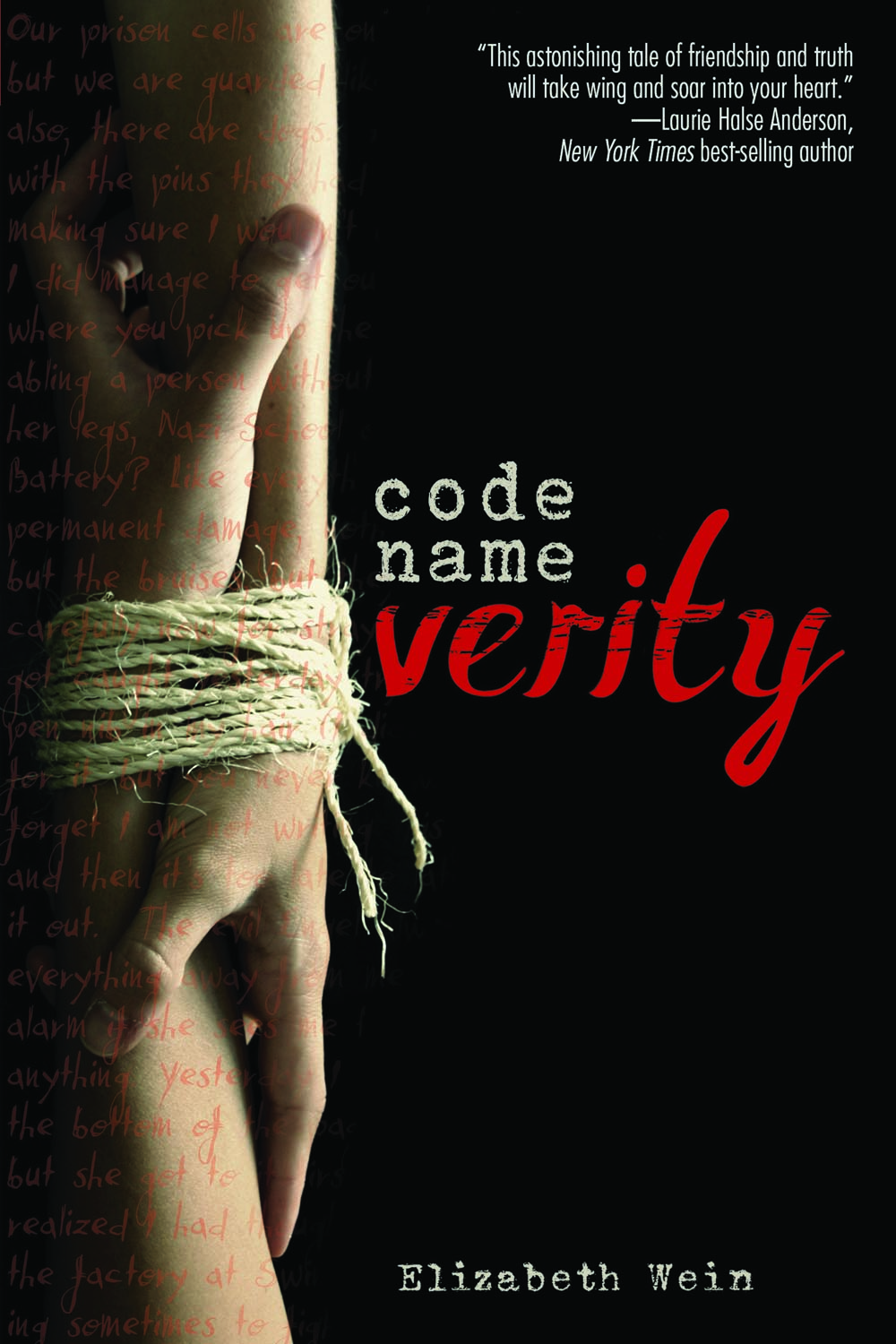
Set in Nazi-occupied France in 1943, “Queenie,” a captured spy is forced to write a confession that encompasses all her knowledge about Allied war efforts.  The result is a novel, scribbled on hotel stationery, recipe cards, and other scavenged paper, which chronicles the wartime friendship that develops between the narrator and Maddie, a Women’s Auxiliary Air Force radio operator turned Air Transport Auxiliary pilot.  Verity scatters just enough details about airplane factories and airstrips to pacify her jailers and torturers, but the real revelations have much less to do with war secrets and much more with true friendship, cowardice, and bravery.
            
The characters in the novel are portrayed with such complexity that readers will relate to Maddie and Queenie even though the historical setting and the dangerous situations in which they find themselves will be far removed from readers.  Queenie proclaims herself a coward in the first sentence of the novel, but so many of her actions and thoughts recorded in her confession make it clear that she has bravely endured hardships and danger and has only been forced into this cowardly act of confessing when she is out of time and opportunity.  Even in torturous conditions, she exhibits some of the same boldness and humor that characterize her early friendship with Maddie.  Queenie’s captor the Nazi officer von Linden could easily become the representation of evil, a Nazi everyman that readers should judge to have no redeeming qualities, but Wein presents him as multi-faceted, with an interest in literature and enough leniency to allow Queenie to tell her story though still a manipulative and cruel villain.  He may never be likable, but he is also not flat.
            
Maddie’s love of flying and her exploits as a pilot allow Wein, who is herself a pilot, to provide significant exposition on types of planes and the mechanics of flying.  These passages can become perhaps too descriptive but the author’s passion for the topic does shine through.  The story is peppered with facts and information about life in Great Britain leading up to and during the war.  Under the guise of confessing all she knows about the war efforts, Queenie is able to communicate to modern readers quite a bit of information about the history of the setting.  Life on a Royal Air Force air field, the Battle of Britain, and the role of women in the war are thoroughly detailed.  Readers may sometimes pause to wonder how she is allowed to write such a personal story by her captors, but ultimately the story is so compelling that suspension of disbelief may not be difficult for readers.

Tuesday, July 16, 2013

Paper Towns by John Green

Green, J. (2008). Paper towns. New York: Dutton Books.

 As children, neighbors Quentin Jacobsen and Margo Roth Spiegelman discover a dead body in the local park, and their friendship is never the same.  Quentin spends the next nine years watching and loving the mysterious Margo from afar.  One Wednesday night near the end of their senior year, Margo reappears in Q’s life, recruiting him to join her on an all night prank adventure.  The next morning as Q begins to wonder what comes next for their relationship, Margo disappears.  This isn’t the first time that Margo has taken off for a few days on an adventure, but when Q discovers a trail of clues she leaves behind, he is certain that he is meant to follow the clues and find her.
            
Reader’s familiar with Green’s Looking for Alaska will find something familiar in this novel.  A reserved, slightly nerdy teenage boy who’s hopelessly entranced by a charming, free-spirited girl will likely remind readers of Miles and Alaska, and there are definite similarities in the dynamics between the two sets of characters.  While Miles finds Alaska fascinating because her attitudes and behaviors are so dissimilar from anything he’s known prior to meeting her, Q grows up next door to Margo and shares in some of those early experiences that shape her, but she still presents a puzzle to Q as her boldness and adventurous spirit are so different from his natural reserve.  Margo’s character is larger than life, and readers may believe Q’s early descriptions of her exploits to be exaggerated, but as the story unfolds, it seems her gift for scheming and thrill-seeking are true.  The other characters in the story especially Q’s two best friends Ben and Radar provide humor and a dose of logic and practicality when Q becomes increasingly absorbed with Margo’s disappearance.  Just as authentically drawn are Q’s parents, therapists who love and support Q but also often see him as they want him to be rather than as he truly is.  This cast of believable characters also seems to emphasize Margo’s dramatic personality.
            
The mystery of Margo’s disappearance is compelling and readers will follow Q’s emotional journey through highs and lows as he follows the clues and searches for her.  Although Q never loses sight of finding out what has happened to Margo, along the way he is just as interested in what the clues tell him about the kind of person that Margo is.  As he searches for her, he comes closer and closer to understanding the person behind the façade she presents to the world.  The mystery story is part of a larger search for identity.  Margo and Q use several different metaphors throughout the book to describe the inner life that represents true personhood, none of which ever completely seem to fit, but by the end of the book, Q is satisfied by what he is able to learn and understand about Margo as well as himself.  While readers may be hoping for a happier conclusion, the resolution of the story fits with the overall tone of the book and provides the answers that those drawn to the mystery of the story will require.
            
Literary allusions are peppered throughout the novel with the most focus on Whitman’s “Leaves of Grass,” which serves as one of Margo’s clues, but fans of the classics will also appreciate the references to the poetry of T.S. Eliot and Emily Dickinson as well as Moby Dick.  Connecting his characters and readers to other literary works is something that Green is able to do in such a way that communicates a clear appreciation and brings a sense of significance of classic literature to his contemporary work.

Tuesday, July 9, 2013

Divergent by Veronica Roth

Roth, V. (2011). Divergent. New York: Katherine Tegen Books.

Set in Chicago sometime in the future, the novel depicts a society that is divided into five factions that value different traits:  Abnegation whose members practice selflessness, Amity known for their peacefulness, Candor who quest for truth, Dauntless who exhibit bravery and daring, and the Erudite who seek knowledge and understanding.  There are also the factionless who are forced to live on the fringes of society.  At sixteen, Beatrice who has been raised in Abnegation, takes the aptitude test that will help her determine which faction she will choose to join.  Her results are inconclusive, and she learns that she is a rare Divergent, someone who possesses an affinity for multiple factions.  Beatrice is warned to keep this information a secret as claiming Divergence could be dangerous.  She chooses to join the Dauntless faction, where she discovers a conspiracy to overthrow the city’s leadership and seize power.  Beatrice’s loyalty to her faction is tested, and she is forced to accept and rely upon all the traits that make her Divergent in order to do the right thing.
            
Roth creates a world that is both recognizable and completely foreign to readers.  Beatrice and other characters in the story must face pressures and influences from family and society while trying to develop a sense of self and choose a path for the future.  The highly regimented faction system may not be a reality, but young readers may feel similar constraints placed on them by peer groups, teachers, or socioeconomic factors.  The depictions of life within the factions show both members who thrive living within the narrow confines of their faction’s defining trait and those who are out of sync or alienated.  There is little room for individuality except for the factionless.  For teens who are often struggling to find a balance between fitting in and autonomy, the society of Divergent could provide some valuable perspective.
            
In addition to the societal issues addressed in the novel, through Beatrice’s training and initiation in Dauntless, readers are exposed to a world of aggression, combat, and survival.  Like other popular dystopian and fantasy novels, the characters find themselves in situations where they must rely on their own strength, skill, and cunning to survive.  While this world of weapons and tactics may not be a part of reality for today’s young adults, these scenarios demonstrate important lessons about strength and strength of character while also providing an escape into a world where characters experience situations and trials that are far removed from the lives of readers.
            
The relationships explored in the novel are another element that will likely be appealing to readers.  Beatrice finds herself making friends with a variety of characters who are very different from her, and the first person narration conveys how these relationships help her to grow out of the sheltered life of her old faction to understand the world more.  The developing love story between Beatrice and her instructor Four is described with emotion and authenticity that will resonate with readers.
            
As with many fantasy and dystopian novels, the main character faces harsh realities and impossible dilemmas, and the overall tone can be read as bleak or dark.  Since this is the first book in a trilogy, there is no bright happy ending to wrap up the story.  The characters face external dangers and villains as well as internal fears and personal grief, and some readers may be depressed by the tragedies and conflicts, but many readers will respond to the complex heroes of Beatrice and Four and find a connection to this story.


Tuesday, July 2, 2013

The First Part Last by Angela Johnson

Johnson, A. (2003). The first part last. New York: Simon & Schuster Books for Young Readers.  

Bobby is a teenage father living in New York City.  He tells his story of life with his newborn daughter Feather and the countless ways that his life is transformed by her existence.  The responsibility of caring for a child at such a young age while still balancing school, family, friends, and decisions about the future is daunting, but Bobby is determined to make the right decisions for his daughter and their future together.
            The novel begins just a few days after Bobby brings Feather home from the hospital.  The chapters alternate between the first few months of her life and flashback descriptions that begin with the day that Bobby’s girlfriend Nia tells him of her pregnancy.  The two timelines blend to create a story that keeps the reader engaged.  Although it’s obvious in one sense where the “Then” chapters are leading since the reader knows from the “Now” story line that Bobby is raising Feather with support but little direct assistance from his parents, it becomes clear early in the novel that both timelines are building towards a climax that the reader may not expect.  The narrative style is episodic in nature, describing key events that lead to future consequences as well as conversations, interactions, or reflections that are representative of the relationships among the characters.  
            Bobby’s narrative voice seems authentic, conveying the fear and confusion alongside his determination and love for his daughter.  He is frank about the realities he faces in raising a child alone, conveying both the resentment he secretly feels about losing his own childhood and the tender devotion and amazement he feels at Feather’s existence.  The novel reads a bit like poetry.  The language is sparse in places but very powerful and descriptive.
            There is foreshadowing leading up to the conclusions of both timelines that connect then and now into one linear story, but Bobby’s final decision about his and Feather’s future may still seem shocking or even unrealistic to readers, especially after the realistic way that Bobby has been portrayed throughout most of the book.  Eve with this slightly incongruous ending, the result  
is a powerful novel.

Where Things Come Back

I enjoyed Where Things Come Back so much that I decided to make it the subject of my book trailer assignment for this class.  One of the requirements was to incorporate spoken narration as well as text.  I hate the sound of my recorded voice so much, I seriously considered hiring someone to do it.  In the end, it's my voice saying "Welcome to Lily, Arkansas."


Tuesday, June 25, 2013

Where Things Come Back by John Corey Whaley

Whaley, J. C. (2011). Where things come back. New York: Atheneum Books for Young Readers.

The small town of Lily, Arkansas is situated halfway between Little Rock and Memphis and is the sort of place that people dream of leaving.  The summer before his senior year of high-school, Cullen Witter witnesses people coming to Lily instead of leaving.  An alleged sighting of the Lazarus woodpecker thought to be extinct for seventy years brings notoriety to Cullen’s hometown.  The woodpecker becomes a symbol for second chances to the people of Lily and the bird enthusiasts who flock there, but when Cullen’s younger brother Gabriel disappears without a trace one night, his family and friends are left hopeless, desperately in need of a second chance. 

Whaley’s novel is rooted in a real place and time.  The ivory-billed woodpecker, long thought to be extinct, was spotted in the Big Woods region of Arkansas in 2004, and its existence  has been the subject of debate among ornithologists for the past several years.  Teens in Arkansas, especially in the central and delta areas surrounding the Big Woods will be old enough to remember the extensive news coverage surrounding the bird as well as the locally-published children’s books such as Big Woods Bird (Luneau & Bennett, 2005) that were distributed in classrooms across the state.  While the story of Gabriel’s disappearance and the Witter family’s struggle to deal with the loss is the true focal point of the novel, the woodpecker subplot is woven throughout and comes to have great significance in Cullen’s recollections of that summer.  Readers familiar with Arkansas may also appreciate the many geographic names from around the state that are used as character names throughout the novel. 

Interspersed with the chapters narrated by Cullen, are sections told from a third-person point of view that introduce the character Benton Sage, a young missionary in Ethiopia and later a college student in Georgia.  His experiences and relationship with his roommate Cabot Searcy at first appear to be completely unrelated to the events unfolding in Lily, but the author eventually weaves these two story lines together through some surprising twists and turns.  Benton and Cabot both demonstrate the same single-minded passion and pursuit of goals that characterizes the zealous woodpecker-seekers in Arkansas, and their particular interest in biblical texts and apocrypha connects to the other storyline through the name of the woodpecker.  Of course, there is no Lazarus woodpecker, the name is an allusion to the biblical story of one who returns from the dead, underlining the hope and belief in second chances that the bird represents to the town. 

Although the novel is has a realistic setting and plot, Cullen’s narration often turns fanciful with extended descriptions of his zombie-filled daydreams and nightmares as well as his notations of amusing book title ideas he records in his journal.  Although these elements provide some humor, it can sometimes be a little tricky for the reader to determine where reality ends and fantasy begins.

Small town life is authentically portrayed as are the teen characters of Cullen, his best friend Lucas, and the various friends, enemies, and love interests Cullen describes.  The descriptions of how each family member and close friend deals with Gabriel’s disappearance as well as Cullen’s perception of how the town bears with them through the loss are vivid and realistic.  Readers who have experienced tragedy or loss will appreciate how the narrative demonstrates the duality of time marching onward and standing still.  Although the subject matter is serious and the emotional descriptions haunting, Whaley provides moments of humor and levity that seem to mimic the ups and downs of real life.

References
Luneau, T. R., & Bennett, T. (2005). Big Woods bird: An ivory-bill story. Little Rock, AR: Kury Lane Inc.


Tuesday, June 18, 2013

Speak by Laurie Halse Anderson

Anderson, L. H. (1999). Speak. New York: Farrar Straus Giroux.


Melinda Sordino enters the ninth grade “clanless,” without a group of friends to define her identity.  Her former friends shun her, and when she does draw the notice of teachers or other students, it’s the wrong kind of attention.  She withdraws into her own haunting thoughts, burying her pain in long silences and a year-long art assignment that will push her to deal with the tumultuous memories that plague her.

Despite the fact that it was written over a decade ago, the subject matter of Speak could have been inspired by much more recent headlines:  a teenage girl, drunk at a party, a victim of sexual assault at the hands of a popular athlete.  The only difference in Melinda’s story and the real-life tragedies that have made news in the past few years is that there’s no social media to testify to what happens to her.  Her rape is a closely guarded secret—one that she manages to compartmentalize and keep even from herself much of the time, yet she is still criminalized by peers who don’t know the whole story.  Melinda is left to deal with the emotional fallout of her ordeal on her own.          

Although Melinda stops communicating with her parents, teachers, and classmates, her first person narration of the story is highly descriptive, full of evocative imagery and perceptive observation of the people and events around her.  Her thoughts and judgments of others are sometimes biting in their sarcasm, but this trait lends an authentic teenage voice to the narration.  The realism, raw emotion, and feelings of powerlessness that Melinda expresses will likely find a ready audience with teenagers who can often feel marginalized and silenced due to parents, teachers, and peers who do not understand or provide support to their inner struggles.

Throughout the novel, Melinda must endure encounters with her attacker who goes to her school, and while he seems to taunt her through these interactions, it’s somewhat unclear whether this is Melinda’s perception or what’s actually happening between them.  A final confrontation near the end of the book brings them face to face once again and seems to reveal her adversary as a person who displays every confidence that he will continue to get away with his abusive treatment of girls.  While it is easy to sympathize and relate to Melinda, even for people who have not experienced a similar trauma, the antagonist and his actions seem almost too horrible to be believed.  Perhaps his character is just as realistic as the others in the story, but the way he maneuvers himself into his final scene with Melinda seems just a little far-fetched.

The difficult subject matter have made this novel the target of challenges and attempted censorship, but the realistic portrayal of the cruelties of high school and adolescence along with the ultimately hopeful message provide ample cause to keep this book on library shelves and easily accessible to teen readers.           

Tuesday, June 11, 2013

I Am the Cheese by Robert Cormier

Cormier, R. (1977). I am the cheese. New York: Knopf.

The story of Adam Farmer begins when he sets out on a bicycle trip from Monument, Massachusetts, to Rutterburg, Vermont to see his father.  Along the way, he encounters dangers of the road, some of his worst fears, and a few helping hands.  Interspersed with Adam’s first person account of his journey and his recollections of happier times are transcripts of interviews between Adam and Brint, a doctor who is trying to help Adam regain his memories.  Through their conversations and Adam’s trip narrative, the clues about Adam’s family and past unravel. 
            The multiple points of view to which the reader has access through Adam’s travel narrative, the interview transcripts, and the third person descriptions of some of Adam’s memories that are recalled during the interview sessions highlight the unreliability of Adam as a narrator while leaving clues and foreshadowing for the reader to solve the mystery of the Farmer family.  Multiple viewpoints or shifts in narration from first to third person may be more common in contemporary young adult literature, but for its time, this was a likely an innovative literary device.  The  events of the story also cast doubts upon certain aspects of the government in a move that mimics the trends in adult literature of the same time and is a precursor to conspiracy theories and exposés that abound in popular fiction (and nonfiction) today.
            Like so many other young adult novels that have remained perennial favorites among both teens and the teachers and librarians who recommend and advocate for them, I Am the Cheese is a story of seeking out identity.  In Adam’s case, this may be a more literal quest than other works, but the story is told in such a way that even if teens cannot relate to the specific circumstances of Adam’s life, they will connect to his exploration of memories as he tries to piece together and explain his life.  The mystery and adventure of his bike trip will also likely resonate with readers who are eager to gain independence from home and family while the treatment of Adam’s many fears along the way can be viewed as reassuring or affirming to readers who may be dealing with their own fears and insecurities about growing up, changing relationships, and identity.  I believe that the accessibility of the teen characters of Adam and Amy in the book and these themes of identity, insecurity, and independence are the greatest strengths of the novel.  As someone who reads a great deal of young adult literature, I can see the influence of Cormier’s writing and characters in the writing of more contemporary realistic fiction.  As I read, I noticed several instances or descriptions that will make this novel seem dated to today’s young readers.  Adam has to use pay phones in his attempts to contact his friend Amy along his journey, and during one of the calls, the operator cuts in to speak to him.  Although I can recall a time before cell phones when pay phones were a necessary part of life, but today’s teens will have little or no reference for this plot point.  Some of the literary and musical references will be similarly outside the experience of current readers.  This could be perceived as a drawback to some teens who aren’t interested in outdated references in books or movies, but the overall strength of the characters, plot, and theme of the story ultimately outweigh this drawback. 


Monday, May 6, 2013

The Palm of my Heart edited by Davida Adedjouma

Adedjouma, Davida. 1996. The palm of my heart: poetry by African American children. Ill. by R. Gregory Christie. New York: Lee & Low Books. ISBN 9781880000410

This collection of poems, a Coretta Scott King Award winner, contains poetry written by African American children as a part of an enrichment program taught by editor Adedjouma.  Each poem begins with the words "Black is . . ." and expresses the young poets' thoughts or experiences concerning race and skin color and identity.  Although each poem begins with the same words, the variety of ideas, themes, and nuances are varied and insightful.  Imagery and word choice are used to convey strong emotions.

While this collection would be inspiring for any young poets, it is a powerful resource for African American students who too often do not hear from writers who look like them or share their experiences.  Not only are the poets published in this volume African American, they are all young people ranging from eight to fourteen years old at the time of publication.To read and experience poetry from children their own age is a valuable experience for young readers and writers.  The illustrations have an appealing style and again feature African American faces that complement the poems.  Each young poet is described in a brief biography at the end of the book.

Featured poem:

Black is dark,
dark is lovely,
lovely is the palm of my heart
and my heartbeats are filled with joy.

by Felicia Renee Brazil

As a way of introducing the poem, I would probably share with students some background about the poetry collection--that the poems were written by students near their own age and that each poet began with the same two words but created a variety of moods, thoughts, and expressions from those two words.  After reading this poem, I would ask the students to discuss the emotions that the poet associates with black and possibly compare it to another poem from the collection.

I would next ask the students to brainstorm to find one unifying characteristic that they all share that could serve as a opening line for a set of poems inspired by the concept of this book.

A Poke in the I selected by Paul B Janeczko

Janeczko, Paul B. 2001. A poke in the I. Ill. by Chris Raschka. Cambridge, MA: Candlewick Press. ISBN 9780763606619


Janeczko has selected thirty previously published concrete poems for this collection illustrated by Chris Raschka.  The variety and visual interest of these poems set this volume apart.  The artwork complements and adds interest and meaning to the unique shapes and forms of the poems.  Rather than relying on the imagery of the words alone, the poems represent and depict movement, shape, and meaning in many ways.  Most of the poems are very brief in word count, but rely heavily on sight and sound to convey meaning and engage interest.

The volume features a variety of poets (including one previously unpublished poem by the illustrator Raschka) with multiple poems by Robert Froman, Douglas Florian, and John Hollander.  While the poems vary greatly in length, complexity, and tone, they are connected by the interactive nature of the visual representations.  The poems and illustrations form one cohesive unit that will appeal to a broad range of abilities, interest levels, and moods of children. Janeczko provides an editor's note to help introduce and explain the idea of concrete poetry.  Several of the poems are grouped on a spread with poems of similar theme or meaning which adds continuity to the collection as a whole, and a table of contents provides access points to the various poems.

Featured poem:

"Popsicle" by Joan Bransfield Graham

Popsicle
Popsicle
tickle
tongue fun
licksicle
sticksicle
please
don't run
dripsicle
slipsicle
melt, melt
tricky
stopsicle
plopsicle
hand all
s
t
i
c
k
y

As it is printed in the book, the poem takes on the shape of a popsicle with all lines except the last word forming a rectangle of text and "sticky" written downward on the page to form the stick of the popsicle.

This poem is a great introduction to concrete poems because it's a simple and obvious shape that corresponds directly to the subject of the poem.  The language, made-up words, rhythm, and rhyme also make it an entertaining choice.

I would share the poem directly from the book to expose students to the shape and illustration.  Further concrete examples could also be shared from the collection.  After reading "Popsicle" and engaging students in some discussion of how shape and placement of a poem can add meaning just as much as word choice, I would encourage students to experiment with shape, font, and illustration of their own poems.

Monday, April 22, 2013

You Read to Me, I'll Read to You by Mary Ann Hoberman

Hoberman, Mary Ann. 2004. You read to me, I'll read to you: very short fairy tales to read together (in which wolves are tamed, trolls are transformed, and peas are triumphant). Ill. by Michael Emberley.  New York: Little, Brown. ISBN 978-0316207447

Part of a series of books by Hoberman that feature poems written to be performed by two readers, this volume features poems based on familiar fairy tales.  Short lines, rhyme, and rhythm are an important to each poem.  The illustrations by Emberley add humor and support to the text.  

The volume contains a table of contents, with each poem titled with the name of the fairy tale.  An author's note discussing the purpose and origin of the concept provides guidance for the performance of the poetry.

Featured poem:

The Three Little Pigs

I'm Big Bad Wolf.
I'm Little Pig.
You're very small.
You're very big.
Bug now I've got you
In my pot.
The water's getting
Very hot.
I'll cook you up
And make a stew.
Why, that's an awful
Thing to do.
Now that's a silly
Thing to say.
You ate my brother
Yesterday.
Why, so I did!
I had forgot.
(This water's getting 
Really hot.)
And on the day before
It's you
Who ate my other
Brother, too.
Did I do that?
That wasn't nice.
(Could you put in 
A little ice?)
They built their houses
In the town.
You huffed and puffed
And blew them down.
Well, they were made
Of straw and sticks
While yours is made
Of good strong bricks.
First I built
My house of bricks,
And then I fooled you
With my tricks.
And now you've got me
In your pot.
This water's really
Really hot!
Say you're sorry
Loud and clear.
I'm sorry.  Let me
Out of here!
Louder!  Clearer!
Give a shout!
I'M SORRY, PIG!
NOW LET ME OUT!
Now do you promise
To be nice?
I promise Pig.
Then here's some ice.
Sit down and cool
Yourself a bit.
I'll read you something
While you sit.
What will you read?
A tale that's true.
A tale about
Both me and you.
Can I read, too?
If you know how.
Of course I do.
Then let's start now.
(Unison)
We'll read Three Little Pigs
Right through
You'll read to me.
I'll read to you.

Since the poem is meant to be performed by two people, I would enlist a second reader and rehearse the poem before presenting to students.  Because the animals are the speakers of the poem, I would use a pig and a wolf puppet to present the poem.

After modeling a performance of the style of poetry contained in the book, I would ask students to team up and present some of the  poems contained within.  Providing costumes, puppets, or props can allow students to create unique performance experiences.  

Button Up! by Alice Schertle

Schertle, Alice. 2009. Button up!: wrinkled rhymes. Ill. by Petra Mathers.  New York: Harcourt Children's Books/ Houghton Mifflin Harcourt. ISBN 9780152050504

Winner of the 2010 Lee Bennett Hopkins Poetry Award and multiple starred reviews from journals, Button Up! is a collection of poems told from the perspective of articles of clothing that are surprisingly articulate and witty.  The illustrations by Mathers depict animal characters as the clothing owners and add detail and humor to Schertle's verses.

All of the poems use rhyme and a strong rhythm that make the poems interesting to read aloud.  Repetition and refrain are also frequently employed in the collection.  The language is appealing, full of enthusiasm and humor.  Even when the articles of clothing take their jobs seriously, the whimsy involved in the concept, illustrations, and poetic language make these poems uniformly entertaining and engaging.

Each poem is titled with the owner's name and the article of clothing and is listed in a table of contents to provide access points into the text.  Each poem gets a two-page spread for poem text and illustrations.

Featured poem:

Joshua's Jammies

We are the jammies that Joshua wears,
not jammies for penguins,
not jammies for bears,
not jammies for tigers with knots in their tails,
not jammies for chickens,
not jammies for whales,
not jammies for elephants going upstairs,
we are the jammies that Joshua wears.
We don't fit iguanas,
we're not for the gnu,
we won't suit the llamas
(they never wear blue).
Hippopotamus can't get us over his head.
We're JOSHUA's jammies.  We're going to bed.

Although the illustrations add such an interesting element to the poem, I would share this poem without showing the illustration to the students.  After reading the poem several times and possibly provided a copy of the text, I would ask students to illustrate this poem.  After students have envisioned their own drawings for the poem, I will share Mather's pictures and compare them to the student's works.  We will discuss how the illustrations affect the meaning of the poem.

Sunday, April 21, 2013

This Is Just to Say by Joyce Sidman

Sidman, Joyce. 2007. This is just to say: poems of apology and forgiveness. Ill. by Pamela Zagarenski. Boston: Houghton Mifflin Co. ISBN 978-0-618-61680-0

"This Is Just to Say" by William Carlos Williams served as inspiration for Joyce Sidman as she worked with students on poetry writing.  When the class encouraged her to send the apology poem she had written to her mother, Sidman was again inspired--this time to write a collection of apology poems from the perspective of a class of sixth grade students.  In this fictional scenario, the students also deliver their apology poems to the intended recipients and ask for poems in response.  The apologies and responses are collected in this volume and illustrated in the fictional setting by one of the students and in reality by Pamela Zagarenski.

The variety of the poems is intriguing and entertaining especially since all the poems have the same intention or purposes--to present an apology or express regret for an action.  The events that inspired the apologies range from the trivial (rubbing a statue's nose for luck) to the more serious (giving in to peer pressure and breaking all the garage windows), and the resulting poems present an emotional range of regret, sorrow, and fear in addition to a few poems showing a lack of serious contrition.  Young readers will find something here with which to identify as the misdeeds are so universal.  In addition to a variety of themes, the types and forms of the poems are also varied including a haiku and a pantoum, although most are free verse.

Most of the poets seem to find freedom or closure from their confessions and apologies, and many of the responses reveal the truth that the offense or inciting incident meant more to the apologist than the one who was wronged.  Most of the offenses have long been forgiven.  A few of the poems written to objects or animals or a couple of parents unwilling to participate are answered by other classmates who offer understanding and absolution as beset they can.

Although rhyme is not used much in this collection, strong rhythms and repetitions or refrains are frequently employed, which makes the poems especially good for oral reading or recitation.  Two poems incorporate Spanish words or phrases, and several of the poems and poets reveal various cultural backgrounds that add an appeal to readers with similar backgrounds.  The illustrations are simple but powerful.  Zagarenski (or the fictional Bao Vang) incorporates dictionary pages into the illustrations in a collage style that highlights significant words or themes (apology, apologize,etc.).  The use of lined paper and graph paper in the illustrations as well as the simple drawings and doodles reinforce the fact that they are supposedly created by a student.

The book is divided into two sections:  apologies and responses and is introduced with an editor's note from one of the students.  A table of contents provides access points for the readers with titles and individual student poets listed.  On each page or spread, the poem's intended recipient is noted above the title.

Featured poem:

Since the poem's are really written in pairs, I would share both the apology and its response.

Fashion Sense (to Mrs. Munz)

I am so sorry for my rude words.

The classroom was so dead.
No one had anything more to say about Old Yeller,
and we were all crazy to get outside.
The silence seemed like a hundred crushing elephants.
So I raised my hand and made that comment
about your dress,
and everyone burst out laughing.

You smiled,
but your smile looked like a frozen pond.

People were high-fiving me on the way
down to lunch, but I felt like a traitor.
You know how the words slip out and you can't believe it?
And they echo in your head forever and ever?
All through lunch, and through recess,
all the next day, I wished I could take those words back.
I kept thinking of what you always say to us:
words can help or hurt, the choice is ours.
I want to rewind to that moment and say instead,
"Mrs. Merz, that dress makes you look like a princess."

You are really a queen not a princess.
Our queen.  Reina de la clase.
I hope you will overlook the transgressions
of your loyal but loud-mouthed subject
and forgive me.

(P.S. I notice you'tr not wearing that dress so much anymore.
Green is not good on you anyway.  I like the new one,
with blue in it, which makes you look thinner.)

by Carmen

Haiku for Carmen

Just these few warm words,
and spring sunlight fills the room;
my dress turns to sky.

by Mrs. Ruth Merz

I think these two poems together demonstrate something important about expression and emotion.  Carmen's poem, one of the longest in the book, has both narrative elements, describing the series of events as well as her thoughts and emotions throughout the whole experience.  Although the poem is related to one specific incident, it shows us several things about Carmen.  She sets the scene in a way that seems to make excuses for why she was rude, but the contrition she describes also seems very sincere.  Her post script also seems to indicate that Carmen can be blunt with her opinion.  Mrs. Merz's poem, whose length is mandated by the haiku form that she chose, is the opposite of Carmen's.  It's brief and spare compared to all the words of the apology poem, but it also tells us quite a bit about Mrs. Merz, that she enjoys her students and basks in warm relationships with them, that she is forgiving, and that no matter how grown up she is, it's still nice to receive compliments.

After sharing the poems, I would engage the students in a discussion of the differences and similarities in the poem.  I would also highlight the line from Carmen's poem about the advice that Mrs. Munz has given, "words can help or hurt, the choice is ours" and ask the students if Carmen's poem demonstrates whether or not she has learned that lesson.

I would also want students to write their own apology poem for some transgression, a misdeed or an unkind word.  Students who want to share their poems would be encouraged to do so.

Monday, April 8, 2013

Black Jack by Charles R. Smith Jr.


Smith, Charles R. 2010. Black Jack: the ballad of Jack Johnson. Ill. by Shane W. Evans.  New York: Roaring Brook Press. ISBN 9781596434738

This ballad depicts the life of heavyweight boxer Jack Johnson who became the first black heavyweight champion in 1910.  In addition to his boxing success, the poem paints a portrait of a proud man, the son of former slaves, who would not accept the racial discrimination that defined the era in which he lived.

The poet uses rhyme and rhythm to create the narrative poem, sometimes incorporating quotes or slang of the time period to lend a more realistic feel to the story.  In addition to relaying the events of Jack's life in poetic form, the ballad also evokes emotion through descriptions of Jack's family and upbringing, the hardships and discrimination that he faced, and the triumphs that he experienced as a boxer.

Featured poem:
an excerpt of the description of his childhood

But it was words from his mother,
whom Jack loved so dear,
that Jack took to heart
when they entered his ear:

"Jack, you are the BEST boy
in the world.  You can do
ANYTHING you want if
you want it badly enough."

Since the entire book is brief, I would be more inclined to share the entire ballad and show off the bold illustrations by Evans, but this poem would also work well on its own to demonstrate how Johnson developed the strong character necessary to cross the color line in boxing and demand equal treatment.

I would share Black Jack as a part of Black History Month in February and ask the students to use the ballad form demonstrated in the poem to write about another figure from history that we studied.

The Brothers' War by J. Patrick Lewis

Lewis, J. Patrick. 2007. The brothers' war: Civil War voices in verse. Washington, D.C.: National Geographic. ISBN 9781426300363

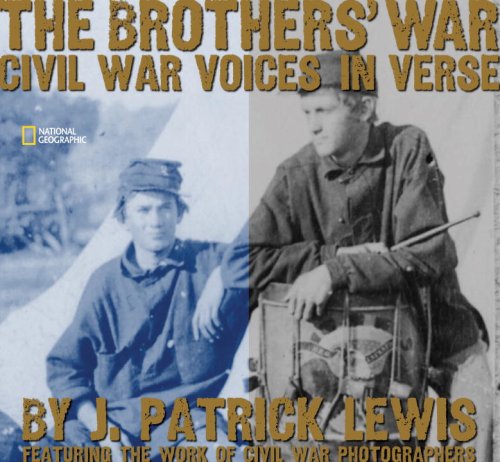
In this collection, J. Patrick Lewis gives a voice to slaves, soldiers, generals, and citizens who were a part of the Civil War.  Each poem is accompanied by photographs from that era as well as a note about the context, person, or situation that is depicted by the poem.  The end of the book features a map, timeline, bibliography for further reading, a note about the photography and Lewis's further notes and explanations of each of the poems.  The table of contents provides access points to the eleven poems.

Each poem is told from a distinct perspective, the speaker a real person or a realistic representative of the time period.  Some are well-known such as abolitionist John Brown or former slave Frederick Douglass or Union General William Sherman, and others are merely the anonymous voices of soldiers and slaves.  Each poem is distinct in perspective and tone, but each also flows together to present a view of the war and time period as a whole.

Most of the poems use rhyme, and many have a strong rhythm.  Word choice and dialect are important to conveying the difference in the speakers of the poem.  The imagery used in the poems is enhanced by the photographs which put faces onto nameless soldiers or depict some of the more gruesome aspects of war.

Featured poem:

Blood of Our Fathers, Blood of Our Sons
The First Battle of Bull Run July 21, 1861

Five thousand fell that day by Sudley Road,
Five thousand left their mothers in despair.
a world gone red--the Bull Run overflowed
With blood, raining in the violent air.
On Widow Henry's fallow fields, I saw
A boy about my age fall where he stood,
Face down, writing, clutching at mud and straw,
As if God's earth could do him any good.
By what outrageous powers of circumstance
Do men take arms against their very own?
The Yankee sergeant's bullet snapped the bone.
Roy Pugh, his Rebel son, had little chance.
Distraught, the sergeant rolled him on his side.
Roy whispered, "Father . . . Why?" before he died.

Although this poem is a depiction of a specific battle, the impact of it truly comes in its depiction of father and son forced into battle against each other by the opposing viewpoints that defined the war.  The poet's note at the end of the book directs readers to a firsthand narrative of a similar event at http://www.eyewitnesstohistory.com/malvern.htm.

I would share first the poem and then the website account with students when discussing the ideological divisions that affected so many families.   Students will write two poems depicting a battle or the overall war from two opposing viewpoints, North and South, slave and slave-owner, etc.

Sunday, April 7, 2013

The Tree that Time Built selected by Mary Ann Hoberman and Linda Winston

Hoberman, Mary Ann, Linda Winston, and Barbara Fortin. 2009. The tree that time built: a celebration of nature, science, and imagination. Napperville, IL: Sourcebooks Jabberwocky. ISBN 9781402225178

Mary Ann Hoberman, the U.S. Children's Poet Laureate from 2008-2010, and Linda Winston, an anthropologist and teacher have selected quite a collection of science and nature poems in this anthology from a wide variety classic and contemporary poets. The volume is divided in nine loosely themed sections and includes section introductions, footnotes, notes on the poets, an index, and a glossary to help guide readers.  The book is accompanied by a cd containing recordings of forty-four of the poems, many read by the poets themselves.  References to track numbers on the cd are included in the table of contents as well as on the pages containing the recorded poems.

With so many poems, there is naturally a wide range of styles, forms, and tones to the poems in this collection.  From brief but richly constructed haiku to fanciful, lighthearted treatments of animals and plants to solemn and sparse depictions of the world, there is sure to be a poem to appeal to all types of readers.  The rhythm, sound, and word choice used in the poems are especially easy to note when listening to the accompanying cd as are the various emotions evoked by the poems.

One of the most appealing aspects of the volume is the inclusion of centuries-old poems alongside poems by the poets of today.  As the anthology's selectors make connections and reference to Darwin's work in evolution, the poems themselves represent an evolution of poetic expression over time.  Simple, playful poems appear alongside more intricate, though-provoking ones, and the whole, while perhaps too extensive to be consumed in a single sitting, provides a variety of avenues to explore and discover making scientists out of poets and poets out of scientists.

Featured poem:

Procyonidae by Mary Ann Hoberman

If you give a little whistle,
You might meet a cacomistle,
A coati or olingo
Or a raccoon with a ring-o;
I can name them by the dozens
And all of them are cousins
                       And they're all related to the giant panda!

The kinkajou's another
That is practically a brother
To coatis and olingos
And to raccoons with their ring-os;
And every single one of them
Is different, that's the fun of them
                       Yet every one's related to the panda!

Now they all have different faces
And they live in different places
And they all have different sizes,
Different noses, different eyeses;
But the family name for all of them
Is just the same for all of them
                       And each one is related to the panda!

The note accompanying this poem explains that when it was written, the panda was classified in the same animal family (Procyonidae) as the raccoon, and the poem connects the panda to its relatives in that family.  In the 1980s, the panda was reclassified based on DNA study into the bear (Ursidae) family.  So although the poem is no longer accurate, it represents how what we know and understand about our world can change as science allows us to discover more and more.

Sharing this poem and the story behind its inclusion in the book would be a wonderful introduction to the scientific method, reminding students that our hypotheses and theories about how or why something is the way it is must stand up to evidence.

Another idea would be to share the recording of the poem (and Hoberman's insight into its background) when studying animal families.  Ask the students to identify traits or aspects of the giant panda that connect it to the raccoon or bear families.  Then ask the students to write an updated version of the poem called Ursidae that connects the giant panda to various relatives in the bear family.  Keeping the same rhythm or rhyme scheme as Hoberman uses in the original poem would be a fun idea to help the poems match each other.

Friday, April 5, 2013

"Restless" by Joyce Sidman

Our midterm project was to create a "poem movie."  Here's my movie for "Restless" by Joyce Sidman, published in The Poetry Friday Anthology for Middle School edited by Sylvia Vardell and Janet Wong.

Monday, March 4, 2013

Things Left Unsaid by Stephanie Hemphill


Hemphill, Stephanie. 2005. Things left unsaid : a novel in poems. New York: Hyperion. ISBN 9780786818501

In her debut novel, Hemphill tells the story of high-school junior Sarah, a model student and daughter, who begins to question her life and decisions.  When she is befriended by Robin, a rebellious classmate, Sarah is drawn to the danger and dark glamour of a new life so unlike her old one.  In the end, Robin's self-destructive lifestyle helps Sarah to realize the danger of blindly following, and she must begin to find her own identity.

The novel is told entirely in titled, free verse poems.  Many can stand alone with interest and meaning outside the context of the novel.  Sarah, as the speaker of all the poems, is honest and vulnerable in depicting her confusion and questioning of life.  The poems contain some narrative elements and dialogue, but many are simply descriptive of Sarah's actions and reactions to the events going on around her.  The language is vivid and descriptive, and the poems convey a strong rhythm.

Teens, especially girls, will be drawn to the clear writing and events and emotions depicted in the novel.  The characters are realistic and representative of several teenage archetypes.  The themes of identity, peer pressure, and friendship are especially relevant to teen audiences.  Hemphill does not shy away from sensitive topics, addressing eating disorders, suicide, alcoholism, and abusive parents with honesty and understanding.

This book was awarded the 2006 Myra Cohn Livingston Award for Excellence in Poetry by the Children's Literature Council of Southern California.

Feature poem:

Under This Skin

I itch,
not pathologically,
but like I'll feel great relief
if I untie my wool scarf

and let my neck bathe
in sunlight.
I'm ready to take
something off

shed the heavy layers.

In the novel, this poem describes Sarah coming out of a time of worry and depression after the attempted suicide of her friend.  She is coming to terms with her own sense of self and getting ready to start living her life on her own terms.  It is a pivotal point in the plot where readers see Sarah start to take control of her life.

With or without the context of the novel, this poems is evocative of throwing off old ways or feelings that weigh down or hold back.  The imagery lends itself to self-expression and new freedom.  This poem would be an excellent introduction to getting students to engage in personal or creative writing such as poetry.  Every year my library holds a teen poetry performance competition, and we try to share poems with them that will inspire them to find or write poems that express their emotions and that also inspire them to speak, read, or recite.  This would be an excellent poem to use an example or inspiration for that purpose.


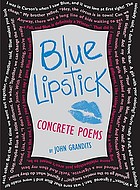
Blue Lipstick: Concrete Poems by John Grandits

Grandits, John. 2007. Blue lipstick: concrete poems. New York: Clarion Books. ISBN 9780618568604

Concrete poems use the shape of the words and lines to convey meaning.  In Blue Lipstick, John Grandits revisits the characters from his earlier book Technically It's Not My Fault as well as the concrete poetry style to tell the story of fifteen-year-old Jessie.  The title poem on the book's cover introduces us to the cast of characters:  Jessie, her parents, her little brother Robert, and best friend Lisa.  We also get a glimpse into Jessie's personality as a girl who likes to be different and take risks.  These relationships and traits are further explored in the rest of the poems in the volume.  

Many of the meanings or themes are enhanced by the forms of the poems themselves, and the visual impact of the poems are as striking as the honest portrayal of teenage life.  Jessie, as the speaker of all the poems, is articulate and creative using figurative language and strong images to convey a wide range of emotions.

The wide range of topics with varying levels of seriousness and angst depict a realistic and relatable portrait of a teenage girl who is by turns angst-ridden, insecure, and insightful.  In her quest to be an individual, Jessie reveals that she is just like everyone else.  Teen readers, especially girls, will relate to the emotions and situations in the poems, and adult readers will also find themselves drawn to the collection.

The poems can mostly stand alone but are enhanced by the unified collection which is arranged in a rough chronology with some poems making references back to previous ones.  The relationships between Jessie and her parents and brother can especially be seen to develop across several poems.  The volume is book-ended by two versions of a poem called "The Wall" that describes the people who are on Jessie's side versus those who are on the opposing side of the wall.  The second version of this poem acknowledges that some people, once considered enemies, have come to Jessie's side of the wall.  

In this collection, Grandits uses his design background to give the poems shape and additional meaning.  The book received a starred review from School Library Journal as well a appearing on SLJ's Best Books of the Year list.  It is an ALA Notable Book and an ALA Quick Pick for Young Adults.  It won a Lee Bennett Hopkins Poetry Honor Award.

Featured poem: 
(The poem is written on black lines surrounding blocks of color in the manner of the art described in the painting.  There are no line breaks in the poem because of its design.)

Mondrian

Dad and I went to the Art Institute.
There was a show of work by Mondrian, and the guy totally rocks!
He did these paintings with just boxes and lines,
and he only used black and yellow and blue and red. 
I mean, he didn't mix his colors at all.
It was so simple and so elegant. 
I said, "I wish I could do that when I grow up--
make ultra-cool radical art."
Dad said, "It's not easy 
to be creative." 
And I thought to myself, "You wouldn't believe how creative
I have to be just to get through the day."
He said, "It's tough being an artist.
You've got to struggle for years.
People often misunderstand your work.
You've got to be thick-skinned because critics can be cruel.
You don't have any money.  And in many ways,
you're really alone."
And I said,
"It sounds like high school."

This poem would be a fun introduction into the art of Piet Mondrian.  After sharing the poem, students could explore his work through the Museum of Modern Art website (http://www.moma.org/collection/artist.php?artist_id=4057).  In an art class, students could also be encouraged to create their own paintings or art pieces showing the influence of Cubism.

Aside from the art connection, the comparison of an artist's life to that of a high school student could lead to a discussion of other occupations or life situations that might also correlate to aspects of teenage life.

The President's Stuck in the Bathtub: Poems about the Presidents by Susan Katz

Katz, Susan. 2012. The president's stuck in the bathtub: poems about the presidents. Ill. by Robert Neubecker. Boston: Clarion Books. ISBN 9780547182216

In forty-three poems, each President of the United States is acknowledged and celebrated for some distinct aspect of his life or presidency.  Although Grover Cleveland is counted as two Presidents because of his nonconsecutive term, he only gets one poem here.  Katz focuses on the more whimsical and lighthearted stories and characteristics of the nation's leaders and provides a few sentences accompanying each poem that give more information on the poem's topic.  The simple cartoonish illustrations by Neubecker add to the humor and playfulness of the poems.

Nearly all of the poems contain some sort of rhyme and occasional approximate rhyme.  Unusual word choices and figurative language also add to the impact of the poems.  One poem particularly that describes Warren G. Harding's alliterative oratory employs impressive alliteration very effectively.  Lincoln's poem, about his trademark stovepipe hat, is a concrete poem with the text set in the shape of the hat.

Many of the poems are narratives describing a particular event.  As this style of poetry has been found to be popular with students, this feature will make the overall book more appealing to young readers.  The variety of topics from Presidential nicknames, pets, and physical oddities to the more noteworthy achievements grants readers a glimpse into the lives of men who have played a fascinating part in American history.  The poems are informative in presenting an overall picture of the lives of the Presidents but also underline the humanity of the larger-than-life characters, allowing readers to find common ground with these famous men.

The poems are presented in chronological order by President, and Katz has maintained a consistent tone throughout, informing, sparking interest, and amusing through vivid and engaging language and careful selection of topics.  All the poems are new and original to this collection.  Each poem and accompanying facts and illustration get their own page or spread.  The table of contents provides access points by poem name as well as by President, and the book ends with a list of additional information about the Presidents including birth and death dates, a quotation, nickname, and one distinctive fact.

Featured poem:

Overdue Mail (Zachary Taylor, 1849-50)

The Whigs have nominated you
for president,
the letter sent
to Zachary Taylor said.
but the Whigs
mailed it
                  postage due.

Taylor didn't want to spend
ten cents,
so he refused that mail,
dispatched it
back to the dead
letter office.
                  There it sat.

After waiting 
for quite some time,
the Whigs decided to invest
a dime
for a second letter,
postage paid.
                  That worked better.

Taylor happily agreed
and led the Whigs
to victory,
the only man in either camp
who won
the presidency
                  by a stamp.

Before or after reading the poem, I might discuss methods of long distance communication with students:  phone calls, text messages, video chat, email, snail mail, etc. and how the avenues available today were not always accessible.  As so much communication is done through more immediate electronic means, the idea of sending a letter and waiting for a response may be new or unusual to students.

This poem could easily fit into a lesson about the historical time period of Taylor's life or the method of mail delivery in 19th century America, but I would probably use it in a writing lesson as a jumping off point to have students write their own letters to the President, a fun way to learn about the form and parts of a letter, addressing an envelope, and most importantly, not forgetting the stamp.


Monday, February 4, 2013

Birmingham, 1963

Weatherford, Carole Boston. 2007. Birmingham, 1963. Honesdale, Pa: Wordsong. ISBN 978-1-59078-440-2

In free verse poems accompanied by historic photos, Carole Boston Weatherford, through the voice of a fictional child speaker, recounts the bombing of a church in Birmingham, Alabama that claimed the lives of four young girls.  The book ends with four in memoriam poems for the four victims of the bombing.  

The poet uses a refrain of sorts "the year I turned ten" for the early poems that set the background for the events, and "the day I turned ten" to introduce the poems that describe the day of the bombing.  Names or lines from various traditional spiritual songs are interspersed throughout the poems, referencing the songs that are synonymous with the African-American community and the Civil Rights movement.  Sense imagery is used to convey the sights, sounds, and emotions as they would have appeared, sounded or felt to a child rather than an adult.  The poems are emotional in a way that will resonate with both adults and children and convey a sense of the tragedy, but despite the serious subject content are not overwhelmingly sad or manipulative.  The memorial poems about the four girls honor lives that were too brief.

Although the book has no table of contents or index, a note from the poet as well as annotations about the photographs provide a historical context for the poems.  The poems are not named individually which also makes them flow together as one long work.

Featured poem:

The day I turned ten,
I saw blood spilled on holy ground
And my daddy cry for the very first time.
What had those girls done to deserve this?

At supper, no one had much appetite.
Afterwards, Mama washed and I dried dishes
While she hummed "Nobody Knows the Trouble I Seen."

Although the poems describe events that take place elsewhere, most students in Little Rock are well-versed in the history of segregation and the Civil Rights movement because of the desegregation of Central High School in 1957.  Sharing this poem could lead to a discussion of what the students already know about the history of their own city and an extension of that knowledge to the efforts and movements in other cities during that era.

I Am the Book

Hopkins, Lee Bennett. 2011. I am the book: poems. Ill. by Yayo. New York: Holiday House. ISBN 978-0-8234-2119-0

This collection of poems selected by Lee Bennett Hopkins all center around the theme of books and reading. The thirteen poems, including one by Hopkins himself, demonstrate the broad gateway to learning and escapism that books provide readers.

The poems employ various devices to convey the richness of language and meaning.  Many employ rhythm or rhyme, and several use personification, making the book as active a participant in the action as the readers described in the poems.  In some cases, as with the titular poem the book is the speaker of the poem.  Though each poem in the book is distinct and meaningful standing alone, the selections blend together very effectively to create a cohesive collection.

Each of the short but meaningful poems contained in this collection are presented on a two-page spread and are accompanied by whimsical painted illustrations by Yayo that support and add meaning and interest to the poems.  Images of books are cleverly worked into the illustrations as boats, oceans, popsicles, and treasure chests among other things to signify the roles of the book in the lives of readers.  The table of contents, which lists each poems and author, provides access points into the text.

 At book's end, the reader is provided with short blurbs about each of the poets whose work is included in the collection.  Most of the poets are well-known contemporary poets, who have won awards and published works in various anthologies or in their own collections such as Karla Kuskin and Jane Yolen.  The book contains one poem by poet Jill Corcoran whose work had not previously appeared in a published anthology.  Most of the poems appear to have been written or copyrighted the same year as the book's publication, but some of the selections are older and have been previously published such as Karen B. Winnick's "Quiet Morning" and Beverly McLoughland's "When I Read."

Featured Poem:
Book
by Amy Ludwig VanDerwater

Buried in blankets
Book in my bed
Snuggled in story
By heart
In my head
I wallow in words
Chapter One
Til The End

Closing the cover
I sigh--

Good-bye, friend.
After sharing this poem with students, I would draw their attention to lines such as "snuggled in story" and "I wallow in words," which combine a concrete, physical action/verb with a object that cannot really receive that action.  I might also point out the last line that addresses the book as a person.  I would encourage the students to come up with other phrases or sentences to show an abstract concept like story could be paired with a physical action verb to create an image of strong interaction.


Sunday, February 3, 2013

A Funeral in the Bathroom

Dakos, Kalli. 2011. A funeral in the bathroom: and other school bathroom poems. Ill. by March Beech. Chicago, Ill: Albert Whitman & Co. ISBN 978-0-8075-2675-0


This collection contains poems all centered around an often-unsung center of life and learning--the school bathroom.  From the expected bathroom humor to the secrets of student life that take place away from teacher's observing eyes, the poems paint a comprehensive picture of school life.

The first poem in the collection "Bathroom Poems" describes a teacher who hangs poems on the walls and stalls of the bathroom causing the students to unintentionally read, experience, and learn poems encompassing a wide range of emotions and forms.  These bathroom poems are referenced in a few poems throughout the collection and seem to serve as the inspiration for the student-narrated poetry that fills the book.

Many of the poems employ rhyme or a strong rhythm which make them enjoyable to read or recite aloud.  The bathroom setting also lends itself to onomatopoeic words that describe the water-filled world.  Thankfully the poet limits most of the sense imagery in the poems to the sights and sounds rather than the smells of the bathroom.

At first glance, a book about bathrooms would appear to have all the slightly taboo appeal needed to draw in young readers.  One might expect the entire book to consist of potty humor and silliness, and while there are such poems in the collection, they are tempered by more serious or imaginative poems that depict the school bathroom as a place that is so much more than its humble purpose:  a place to hide, to seek comfort or solitude, a place to daydream or escape the mundane, a place to for students to be themselves.  Young readers will respond to the images and experiences depicted in these poems.


For the most part, the collection is formatted with one poem per page.  A few poems are long enough to take up an entire two-page spread, and a number of the shortest poems share a page.  No matter the length, each poem is illustrated by Mark Beech.  The simple but colorful drawings give as much life to the toilets and mirrors as to the students who appear in the poems.  Many of the illustrations help to further the humor of the poems but they are not crude, which is a fine line to walk given the subject of some of the poems.  Of course, not all the poems are humorous, but the Beech's drawings support the poems no matter the topic or meaning.  The table of contents at the beginning of the book provides access points to the forty-one poems that make up the collection.

With her background as an educator, it's not surprising that  Kalli Dakos finds inspiration for her poetry in the school setting.  In addition to this anthology, she has published more school related poems in If You're Not Here, Please Raise Your Hand and The Bug in Teacher's Coffee and Other School Poems as well as contributing poems to other school poetry anthologies such as There's No Place Like School:  Classroom Poems.  


Featured Poem:
Stuck in His Shoe

He didn't have
a single clue
when the toilet paper
stuck to his shoe.

And followed him
in a looooooooooong line
down the hall
past the office sign,

and right into
our spelling class,
where everyone

laughed

and laughed

and laughed!

The poem could be introduced by sharing a personal story of an embarrassing moment or by asking students to share embarrassing anecdotes.

Tuesday, January 15, 2013

Change of Pace

This semester, I'll continue this review blog for my Poetry class.  I'll be sharing reviews of poetry books as well as ideas for using poetry with children/students.  I might even link up to Poetry Fridays.

Since I have another excuse to keep blogging alive, perhaps I'll even manage to keep it going once grad school is over. (No promises, of course.)